>

What Material Is an Engine Block Made Of?

What Material Is an Engine Block Made Of?

目次

The engine block is the structural backbone of any internal combustion engine. It houses the cylinders, coolant passages, oil galleries, and mounting points for virtually every major engine component. Choosing the right material for this critical part is not just an engineering decision — it is a manufacturing, 料金, and performance decision that affects the entire vehicle lifecycle. それで, what material are engine blocks made of, and why does it matter so much? This article breaks it all down, from traditional cast iron to modern aluminum alloys, and explores how precision die casting is reshaping engine block manufacturing.

The Most Common Materials Used in Engine Blocks Today

Historically, engine blocks were made almost exclusively from gray cast iron. It is dense, strong under compression, and relatively inexpensive to produce through sand casting. For decades, it served the automotive industry well — particularly in heavy-duty trucks, diesel engines, and high-displacement V8s where brute strength was the priority.

しかし, the modern automotive landscape has shifted dramatically. Fuel economy regulations, emissions standards, and the rise of turbocharged small-displacement engines have driven a major transition toward aluminum alloy as the primary material of engine block production.

今日, the two dominant materials are:

  • Aluminum alloy (例えば, ADC12, A380, AlSi9Cu3) — used in the majority of passenger car engines
  • Gray/compacted graphite cast iron — still prevalent in diesel engines, heavy trucks, and high-performance applications

A small number of specialty applications also use magnesium alloys or composite materials, but these remain niche due to cost and manufacturing complexity.

Aluminum vs Cast Iron: Which Engine Block Material Wins

The debate between aluminum and cast iron is not simply about which is “より良い” — it is about matching material properties to application requirements. Each has distinct advantages and trade-offs.

財産 アルミニウム合金 ねずみ鋳鉄
密度 ~2.7 g/cm3 (軽量) ~7.2 g/cm³ (heavy)
熱伝導率 ~150–200 W/m·K (excellent) ~40–50 W/m·K (moderate)
圧縮強度 適度 (requires reinforcement) 高い (excellent under load)
Thermal Expansion ~23 µm/m·K (higher) ~11 µm/m·K (lower)
被削性 素晴らしい (faster, lower tooling wear) 良い (but slower, more tool wear)
リサイクル性 Very high (~95% recovery rate) 高い (but energy-intensive remelting)
代表的な用途 Passenger cars, hybrids, EV Diesel, heavy-duty, racing engines

For most modern passenger vehicle applications, aluminum alloy is the clear winner. But for high-compression diesel engines or applications where block rigidity under extreme load is paramount, cast iron still holds its ground.

Thermal Conductivity and Weight

Two properties consistently drive material selection for engine blocks: thermal conductivity and weight.

熱伝導率 determines how efficiently heat is transferred away from combustion zones. Aluminum dissipates heat roughly 3–4 times faster than cast iron. In modern turbocharged and high-revving engines, this difference is critical — it reduces the risk of hotspots, improves combustion efficiency, and allows for tighter bore-to-bore tolerances. Effective heat management also means the cooling system can operate more efficiently, contributing to overall vehicle fuel economy.

Weight reduction is equally compelling. An aluminum engine block typically weighs 40–50% less than its cast iron equivalent. At a vehicle system level, this reduction lowers the center of gravity, improves power-to-weight ratio, and directly supports fuel efficiency targets. For OEMs under pressure to meet CAFE or EU CO₂ fleet standards, shaving 20–30 kg from the powertrain is a significant competitive advantage.

Together, these two properties explain why aluminum has become the material of engine block choice for most new passenger car platforms launched in the past two decades.

Why Aluminum Alloy Dominates Modern Engine Block Manufacturing

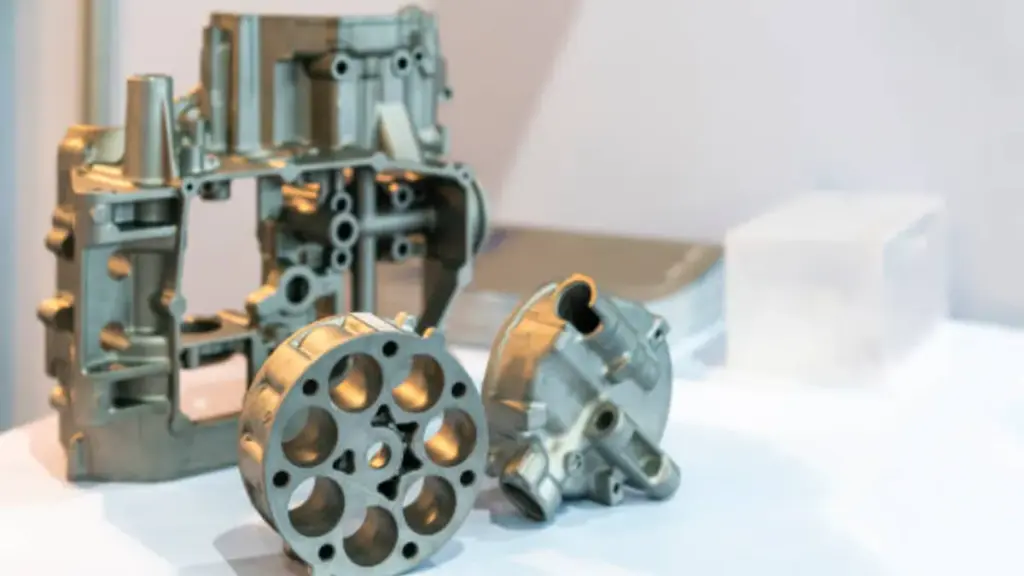
Beyond performance, aluminum’s dominance is also driven by manufacturing economics. Aluminum alloys are highly compatible with high-pressure die casting (HPDC), a process that enables complex near-net-shape geometries, 薄い壁, and integrated features like coolant galleries — all in a single shot. This dramatically reduces the number of secondary machining operations compared to sand-cast iron blocks.

Modern OEMs and Tier 1 suppliers have invested heavily in aluminum die casting infrastructure because it aligns with three strategic priorities:

  1. Lightweighting mandates driven by global emissions regulations
  2. Electrification — EV and hybrid powertrains rely on compact, lightweight aluminum structural components
  3. Manufacturing efficiency — shorter cycle times and lower post-processing costs versus iron casting

Understanding what material are engine blocks made of in today’s vehicles almost always leads to aluminum — specifically die-cast aluminum alloys optimized for casting fluidity, 機械的強度, and post-processing compatibility.

Aluminum engine blocks are just one part of the broader shift in what modern automobiles are made of in the lightweight manufacturing era.

HPDC vs Gravity Casting

Not all aluminum casting processes are equal. The two primary methods used for engine blocks are High-Pressure Die Casting (HPDC) and gravity casting (including low-pressure permanent mold casting). Each produces a different microstructure — and therefore different mechanical properties.

HPDC injects molten aluminum into a steel die at pressures of 700–1,000 bar. The rapid solidification produces a fine-grained microstructure with excellent surface finish and dimensional consistency. しかし, the high-speed injection can entrap air, creating porosity — a critical concern in pressure-bearing components like engine blocks. Advanced HPDC lines mitigate this through vacuum-assisted die casting, real-time die temperature control, and optimized gating design.

重力鋳造 fills the die under gravitational force alone, resulting in slower solidification and a coarser grain structure. While porosity is lower due to the gentler fill, cycle times are longer and wall thickness must generally be greater to ensure fill completeness. This process is often preferred for safety-critical or high-integrity components where internal soundness takes priority over cycle time.

For high-volume automotive engine block production, HPDC — especially vacuum-assisted HPDC — has become the industry standard, delivering the speed, 精度, and material efficiency required at scale.

ADC12 and AlSi Alloys: Porosity Control in Die Cast Engine Blocks

The specific alloy chosen for die casting an engine block has a direct impact on porosity, 収縮, and mechanical performance. Among the most widely used alloys are ADC12 (equivalent to A383) and AlSi9Cu3 (EN AC-46000).

合金 Si Content Key Characteristic Typical Use
ADC12 / A383 9.6-12% Excellent fluidity, 低収縮, good corrosion resistance General engine components, ハウジング
AlSi9Cu3 (EN AC-46000) 8–10% 高強度, 良好な機械加工性, moderate porosity risk Structural engine blocks, シリンダーヘッド
AlSi12 (A413) 11–13% Best fluidity, lowest shrinkage, ideal for thin-wall casting Complex geometry blocks, integrated components
A380 7.5–9.5% Balanced strength and castability, widely available Automotive structural parts, North American market standard

Porosity control is the central challenge in die casting engine blocks. Internal porosity — microscopic voids left by trapped gas or shrinkage — can compromise pressure integrity and fatigue life. Best-in-class manufacturers address this through:

  • Vacuum-assisted die casting to remove air from the cavity before injection
  • Mold flow simulation (Magmasoft, Flow-3D) to optimize gate location and fill sequence
  • X-ray and CT inspection to verify internal soundness on critical components
  • Controlled die temperature to manage solidification front and minimize shrinkage porosity

When porosity is controlled to below 0.5% by volume in critical zones, aluminum die cast engine blocks can achieve gas-tightness ratings comparable to or exceeding sand-cast iron alternatives.

Precision Aluminum Die Casting Solutions for Engine Block Manufacturing

For OEMs and Tier 1 suppliers sourcing aluminum die cast engine components, the choice of manufacturing partner matters as much as the choice of alloy. ビアン・ザ・キャスト (Foshan Nanhai Beyond Metal Co., 株式会社) is a one-stop aluminum die casting manufacturer in China, offering fully integrated services from tooling development through to finished, inspected components ready for assembly.

BIAN Die Cast’s capabilities include:

  • コールドチャンバーダイカスト with machines ranging from 160T to 1,250T — covering small bracket components through to large engine housings and structural blocks
  • In-house CNC machining と 100+ multi-axis machining centers for bore finishing, critical surface machining, and tight-tolerance features
  • Vacuum die casting and mold flow analysis for porosity-sensitive automotive applications
  • Full surface treatment 能力: パウダーコーティング, 陽極酸化処理, electroplating, and passivation
  • IATF 16949 およびISO 9001 certified 品質システム, with CMM, X線, spectroscopy, and salt spray testing in-house

Beyond China, BIAN operates a Mexico plant to serve North American customers with near-shore production, reduced lead times, and tariff-friendly supply chain solutions. これ “中国 + メキシコ” dual-base model provides OEM customers with supply chain resilience and the ability to optimize between cost efficiency and delivery speed.

Explore BIAN’s full range of die casting products そして 自動車部品, or contact the team directly to discuss your engine component sourcing requirements.

よくある質問

Is Aluminum Engine Block More Expensive Than Cast Iron Really?

The answer depends on how you definecost.The raw material cost of aluminum is higher per kilogram than cast iron. しかし, when you factor in the full production economics, aluminum often comes out ahead:

  • サイクルタイムの短縮 in HPDC vs sand casting for iron
  • Significantly less machining is required due to near-net-shape die casting capability
  • Lower tooling wear on CNC equipment machining aluminum vs iron
  • Lighter shipping weight reduces logistics cost per unit
  • Higher scrap value — aluminum recovers 85–95% of its material value at end of life

For high-volume automotive production, the total cost of ownership for an aluminum die cast engine block is frequently competitive with or lower than an equivalent cast iron block when all downstream processes are included.

How Long Does an Aluminum Engine Block Last?

A properly designed and manufactured aluminum engine block can last the full service life of the vehicle — typically 200,000 miles or more under normal operating conditions. The key variables are alloy selection, 熱処理, cylinder bore reinforcement (via cast-in iron liners or thermal spray coatings), and quality of the die casting process itself. Porosity defects, if present, are the most common source of premature failure, which is why rigorous X-ray and pressure testing are essential in automotive-grade production.

Can an Aluminum Engine Block Handle High Compression Diesel Engines?

This is the primary application where cast iron retains an advantage. High-compression diesel engines — particularly heavy-duty commercial applications running at 18:1 に 22:1 compression ratios — subject the block to extreme cylinder pressure and thermal cycling. Aluminum’s lower compressive strength and higher thermal expansion coefficient create fitment and sealing challenges at these extremes. しかし, modern compacted graphite iron (CGI) and advanced aluminum alloys with reinforced bore structures are beginning to challenge this assumption even in medium-duty diesel applications.

What Alloy Is Most Commonly Used in Aluminum Engine Blocks?

ADC12 (Japan/Asia standard) and its equivalent A383 (North American standard) are the most widely used alloys in die cast engine components globally, due to their excellent combination of casting fluidity, 寸法安定性, 耐食性. For higher-strength structural applications in European automotive platforms, AlSi9Cu3 (EN AC-46000) is the alloy of choice. All of these alloys are routinely processed through HPDC with vacuum assistance for engine block and engine-adjacent structural components.

共有:

私達にメッセージを送ります

目次

ワッツアップ

USMCA認定ダイカストの見積もりをリクエストする