>

아연 다이캐스트 재료 가이드: 합금, 속성, 및 디자인

아연 다이캐스트 재료 가이드: 합금, 속성, 및 디자인

목차

Choosing the wrong zinc die cast material is the single decision that can lead to catastrophic component failure, forcing expensive product recalls and halting production lines. A slight mismatch between an alloy’s properties and its application’s mechanical stress or environmental exposure can result in premature cracking, corrosion, or structural instability. This single point of failure invalidates entire engineering cycles, wastes tooling investments, and puts supply chain commitments at risk.

This guide provides the definitive technical data required to specify the correct zinc alloy for your application. We will break down the key differences between Zamak and ZA alloys, comparing their mechanical strength, 경도, and thermal properties. We will also cover essential design-for-manufacturability (DFM) principles, including wall thickness optimization, draft angles, and tolerance standards, before exploring the final finishing options for cosmetic and protective purposes.

소개: Why Zinc Alloys Dominate Precision Manufacturing

Zinc alloys deliver superior dimensional accuracy and lower production costs through high fluidity and extended tool life, making them ideal for complex, high-volume manufacturing.

Achieving Tight Tolerances with Superior Fluidity

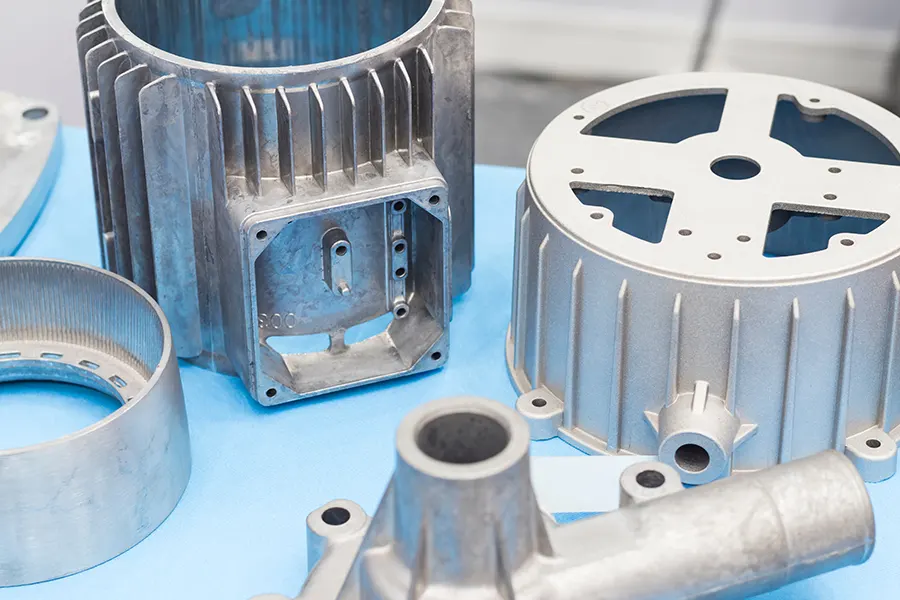
Zinc’s exceptional fluidity in its molten state is the key to its precision. This property allows the alloy to fill intricate mold cavities completely, producing net-shape parts with unmatched dimensional accuracy—typically achieving tolerances of ±0.05 mm in die casting and as fine as ±0.01 mm with secondary CNC machining. This precision enables the creation of components with extremely thin walls, 아래로 0.3 mm, without sacrificing structural integrity. Designers can also specify minimal or even zero-draft angles, which simplifies part design and reduces material waste. The resulting as-cast surface finish (Ra ≤ 1.6 µm) is smooth enough to eliminate the need for most secondary polishing operations, further streamlining production.

Lowering Production Costs via Extended Tool Life

A significant economic advantage of zinc alloys is their low melting point of approximately 419.5°C. This lower operating temperature drastically reduces thermal stress on die casting molds, extending tool life to over 1,000,000 cycles—far beyond what is possible with higher-temperature materials like aluminum. The material also has a high machinability index (over 90%), which minimizes tool wear during secondary operations and shortens cycle times. Zinc is also fully recyclable without degradation of its mechanical properties. This allows foundries to remelt and reuse all process scrap, creating a sustainable, closed-loop system that reduces raw material costs for mass production.

Balancing Strength, Wear Resistance, and Versatility

Zinc alloys offer a robust combination of mechanical properties, 높은 인장 강도를 포함하여 (ranging from 280–430 MPa) 그리고 충격 저항, making them suitable for load-bearing structural components. The availability of specialized alloys allows for performance tuning to meet specific application demands. 예를 들어, the ZA family of alloys (like ZA-8) provides enhanced hardness and wear resistance for bearing applications, while advanced formulations like EZAC deliver superior machinability for complex instruments. This versatility extends to manufacturing processes; zinc is adaptable to high-pressure die casting, 정밀 CNC 가공, and cold forming, giving engineers the flexibility to produce complex geometries efficiently.

아연 다이 캐스팅 과정: Hot Chamber Efficiency

Hot chamber die casting integrates the furnace and injection system, enabling unmatched cycle speeds and material integrity for high-volume zinc component production.

Integrated Gooseneck Design for Rapid Injection Cycles

In the hot chamber process, the injection mechanism, known as a gooseneck, is permanently submerged in the molten zinc bath. This design feeds liquid metal directly into the injection cylinder, completely eliminating the ladling step required in cold chamber methods. The result is a much faster cycle time. Production rates for standard parts typically range from 350 에게 450 shots per hour, while micro-castings can achieve rates of 2,000 에게 3,500 per hour. The submerged plunger system automatically refills after each shot, ensuring a consistent and immediate supply of metal for the next cycle, which is essential for maintaining efficiency in high-volume manufacturing.

Reduced Porosity Through Direct Metal Injection

Keeping the injection system fully immersed in the molten metal minimizes exposure to the atmosphere. This significantly reduces the chances of air entrapment and metal oxidation during the injection process. The direct, enclosed transfer produces denser, less porous castings with superior mechanical integrity. This is critical for demanding applications like structural automotive components where internal voids are unacceptable. This method also produces an excellent as-cast surface finish, often achieving a roughness average (라) of 1.6 µm or less, which reduces or eliminates the need for secondary machining and polishing.

Maximizing Tool Longevity and Lowering Energy Use

Zinc’s low melting point, around 419.5°C, is a key operational and economic advantage. This relatively low temperature subjects the steel die casting molds to far less thermal shock and wear compared to casting higher-temperature alloys like aluminum. This extends the functional life of a typical mold to well over one million cycles, dramatically lowering the amortized tooling cost per part. The integrated furnace design is also more energy-efficient, as it maintains a stable melt temperature with less heat loss than external furnace and ladling systems. This translates to lower overall energy consumption and reduced production costs.

IATF-Certified Die Casting for Mission-Critical Components

Our integrated process, from DFM analysis to automated finishing, eliminates supply chain risks and reduces your total landed costs. We deliver complex, zero-defect components that boost your profitability and protect your brand’s reputation.

Explore Our Solutions →

CTA 이미지

Detailed Breakdown of Zinc Alloys: Selecting the Right Grade

Choosing the right zinc alloy grade directly impacts a component’s mechanical performance, dimensional stability, and final production cost. This is a critical engineering decision, not a commodity choice.

잔뜩 3: The Standard for Dimensional Stability and Finishing

잔뜩 3 is the established baseline for the Zamak series and the most widely specified zinc alloy in North America, accounting for over 70% of die casting volume. It provides an excellent combination of mechanical properties, exceptional castability, and long-term dimensional stability. Its primary advantage is its superior surface quality, which creates an ideal substrate for plating, 그림, and other cosmetic finishes. With a tensile strength of around 283 MPa, it serves as the default, cost-effective choice for general-purpose components, 하우징, and decorative hardware where precision and appearance are critical.

잔뜩 5: Increased Strength and Hardness

잔뜩 5 is a direct enhancement of Zamak 3, modified with approximately 1% copper content. This addition increases its tensile strength to around 331 MPa, a measurable improvement of about 10%, and also boosts its hardness and creep resistance. The trade-off for this increased strength is a reduction in ductility (elongation drops from ~10% to ~7%), making it less suitable for parts that require secondary forming operations like bending or crimping after casting. 잔뜩 5 is specified for applications that demand higher structural integrity and load-bearing capability, such as automotive components and mechanical hardware.

for-8: High-Performance Alternative for Bearing and Wear

The Zinc-Aluminum (ZA) alloys offer mechanical properties that surpass the Zamak family. for-8, with an 8.4% aluminum content, provides significantly higher strength, 경도, and excellent bearing properties. It is frequently specified to replace machined bronze or cast iron parts in high-wear applications. A key manufacturing advantage of ZA-8 is its ability to be cast using the efficient hot-chamber die casting process, unlike the higher-aluminum ZA-12 and ZA-27 alloys, which require the slower cold-chamber method. This makes ZA-8 a cost-effective solution for high-performance mechanical components.

EZAC Alloy: Superior Creep Resistance for High-Stress Environments

EZAC is an advanced formulation engineered to solve one of traditional zinc’s primary limitations: creep resistance, especially at elevated temperatures. This alloy maintains its dimensional integrity under sustained loads where other zinc alloys would deform over time. It offers an order of magnitude improvement in creep performance, making it ideal for critical applications with constant tension. Common uses include structural connectors, threaded fasteners, and automotive components operating in high-stress thermal environments, all while retaining the production advantages of hot-chamber die casting.

Comparative Analysis for Application-Specific Selection

Material selection is driven by specific performance requirements. Use this framework as a starting point for engineering decisions.

  • 잔뜩 3: The default for cost-effective, high-precision parts requiring excellent cosmetic finishes.
  • 잔뜩 5: Choose when a component requires a measurable increase in tensile strength, 경도, and creep resistance over Zamak 3.
  • for-8: Select for mechanical parts that need superior durability, 내마모성, and bearing properties, especially if replacing bronze or iron.
  • EZAC: Specify for critical applications where long-term load and temperature stability are non-negotiable to prevent creep deformation.

Zinc Die Cast Material Properties & Performance Data

Zinc’s distinct material properties enable high-precision, net-shape parts with extended tool life, directly lowering per-unit production costs for complex components.

Mechanical Strength & Physical Characteristics

Zinc alloys deliver a reliable balance of high tensile strength, impact resistance, and wear resistance required for demanding industrial and automotive applications. The material’s high fluidity in its molten state is a key manufacturing advantage, allowing it to fill intricate die cavities completely. This enables the casting of complex parts with extremely thin walls, down to a minimum of 0.3 mm, without sacrificing structural integrity. The process also yields a superior as-cast surface finish with roughness values (라) of 1.6 µm or less, often eliminating the need for secondary polishing or finishing operations.

Dimensional Stability & Tolerance Standards

Zinc’s primary advantage over competing materials is its exceptional dimensional stability and precision. It consistently maintains a die casting dimensional accuracy of ±0.05 mm, a standard that rivals many machining processes. For features requiring even greater precision, subsequent CNC machining can achieve tight tolerances of ±0.01 mm. This high level of accuracy allows engineers to design components with very small or even zero-draft angles. This capability enables the production of net-shape parts that optimize internal volume and mechanical efficiency, reducing both material waste and post-processing steps.

Thermal & Machinability Performance

The operational and economic benefits of zinc are directly tied to its thermal properties and machinability.

  • A low melting point of around 419.5°C reduces thermal stress on tooling, dramatically extending mold life beyond 1,000,000 cycles—far surpassing the lifespan of dies used for aluminum casting.
  • Zinc has an excellent machinability index (over 90), which minimizes tool wear during secondary operations and reduces overall processing time.
  • The material is fully and infinitely recyclable without loss of mechanical properties, supporting closed-loop manufacturing and sustainability initiatives.

Design Guidelines for Zinc Die Casting (DFM)

Effective Design for Manufacturability (DFM) for zinc casting directly cuts costs by minimizing secondary operations and ensuring component precision from the start.

벽 두께, 구배 각도, and Tolerances

Zinc’s high fluidity allows for the design of complex, lightweight parts with extremely thin walls, specified as low as 0.3 mm without compromising structural integrity. This material property also enables the incorporation of minimal draft angles, including zero-draft features on internal surfaces where feasible, reducing the need for subsequent machining. For high-precision components used in automotive or electronics, designs can confidently target standard die casting tolerances of ±0.05 mm, a level of accuracy difficult to achieve with aluminum or molded plastics.

재료 선택: 잔뜩 3 대. 잔뜩 5

Choosing the correct alloy is critical for performance. 잔뜩 3 is the standard for applications that demand superior dimensional stability and excellent finishing characteristics for plating or painting. When the design requires higher mechanical performance, select Zamak 5. Its 1% copper content provides a roughly 10% increase in tensile strength (까지 331 MPa) and improved creep resistance, making it ideal for structural components. 비안다이캐스트에서, all material specifications comply with ASTM, 안에, and JIS standards to ensure global consistency across our China, 멕시코, and Vietnam facilities.

  • 잔뜩 3: Best for dimensional accuracy and decorative finishes.
  • 잔뜩 5: Preferred for load-bearing applications needing higher tensile strength and hardness.

Integrating Features to Reduce Secondary Machining

One of zinc’s primary manufacturing advantages is its ability to produce net-shape parts. By leveraging the alloy’s high fluidity, you can design cast-in threads, 상사, standoffs, and inserts directly into the component. This strategy eliminates entire post-processing assembly steps, reducing labor costs and production cycle times. The goal is to achieve an as-cast surface finish of Ra ≤ 1.6 µm, which often minimizes or completely avoids the need for subsequent polishing, further streamlining the manufacturing workflow from mold to finished part.

Surface Finishing Options: Plating and Coating

The right surface finish determines component durability, 내식성, and electrical performance—a critical engineering choice for application-specific reliability.

Coating for Durability and Aesthetics

We provide two primary coating solutions based on part requirements. Powder coating applies a thick, durable polymer barrier, creating a hard, plastic-like shell ideal for industrial and automotive parts that demand high resistance to corrosion, scratches, 그리고 자외선 노출. For applications where appearance is the priority, wet painting offers an extensive color palette and can achieve high-gloss, Class-A finishes. Our unified quality management system ensures color and finish consistency across all manufacturing bases in China, 멕시코, 그리고 베트남, guaranteeing your brand standards are met regardless of the production origin.

Plating and Chemical Treatments for Functional Performance

When functional properties are the primary goal, we utilize specific plating and chemical treatments. Electroplating applies thin metallic layers, such as nickel or chrome, to enhance electrical conductivity, improve wear resistance, or provide superior corrosion protection. For aluminum components, anodizing creates a hard, non-conductive oxide layer that significantly increases surface durability. Passivation is a chemical process that maximizes the base material’s natural corrosion resistance by forming a protective surface film, a critical step for parts exposed to demanding environmental conditions.

Matching the Finish to the Application

Selecting the correct finish is an application-driven engineering decision. There is no single solution for all scenarios.

  • 자동차 & Industrial: We select finishes that meet IATF 16949 표준, focusing on verified performance in salt spray testing and long-term wear resistance.
  • 5G & 전자제품: Coatings are chosen for their EMI shielding capabilities and thermal management properties to ensure reliable signal integrity and effective heat dissipation in sensitive enclosures.
  • Outdoor Equipment: For components like LED lighting housings, we apply UV-stable and weather-resistant powder coatings to guarantee long-term operational reliability against environmental exposure.

Sustainability and Cost-Efficiency Analysis

A multi-base manufacturing strategy combines material efficiency, tariff optimization, and supply redundancy to reduce total landed costs and ensure long-term production stability.

Material Lifecycle and Process Efficiency

Our manufacturing process is built on sustainability and cost reduction in compliance with ISO 14001 표준. We utilize highly recyclable aluminum, 아연, and magnesium alloys to minimize waste. Zinc alloys provide a distinct advantage due to their low melting point of approximately 419.5°C, which significantly reduces energy consumption during casting. This low operational temperature also minimizes thermal stress on tooling, extending die casting mold life beyond 1,000,000 사이클. This durability results in a lower amortized tooling cost per part, a direct saving passed to our clients.

This focus on efficiency extends through our entire logistics chain. We engineer optimized container loading designs for all ocean freight to maximize spatial usage. This tactical approach reduces the per-unit shipping cost and lowers the associated carbon emissions for each shipment, aligning cost savings with environmental responsibility.

Global Production Strategy for Tariff Optimization

We operate a “중국 + 2” global manufacturing layout specifically designed to manage tariffs and geopolitical risk. By shifting mass production to Vietnam or Mexico, clients can leverage Free Trade Agreements (FTAs) to substantially reduce or eliminate import duties for products entering North American and European markets. This strategy provides a direct and predictable cost advantage in today’s trade environment.

Our model centralizes high-skill, cost-effective operations where they make the most sense. 신제품 소개 (NPI) and precision tooling development are managed in our China technology center. Once validated, mass production is transferred to the most tariff-advantaged location for final casting and assembly. To make this cross-border model economically effective, shipments from Vietnam and Mexico have recommended Minimum Order Quantities (MOQ) of 3,000 에게 5,000+ 단위. This volume amortizes logistics and operational overhead, maximizing total cost savings.

Supply Chain Resilience and Risk Mitigation

Our tri-base manufacturing model, 중국에 시설이 있는, Vietnam, 그리고 멕시코, is engineered for supply chain resilience. This distributed footprint provides immediate production redundancy. If a regional trade disruption or force majeure event impacts one location, we can reroute production to another facility to ensure absolute supply continuity for our clients.

Component quality is non-negotiable, 출신에 상관없이. We enforce a single, unified quality management system across all facilities, certified to the IATF 16949 자동차 표준. This guarantees that a part cast in Mexico is dimensionally and functionally identical to one cast in Vietnam or China, preventing defects and ensuring seamless integration into your production line. This diversified approach delivers critical, long-term benefits.

  • Production Redundancy: Mitigates risks from regional trade disputes or logistical bottlenecks.
  • Geopolitical Stability: Allows for flexible production allocation to navigate changing international trade policies.
  • Stable Long-Term Pricing: Reduces exposure to currency fluctuations or sudden tariff implementations in any single country.

결론

Choosing the right zinc alloy, from the versatile Zamak 3 to high-strength ZA grades, directly impacts component performance, 비용, 및 제조 가능성. Applying the material property data and design guidelines outlined here helps ensure your parts meet precise functional requirements. This informed approach prevents over-engineering and aligns material selection with your project’s specific mechanical and environmental demands.

Use this information to refine your next design or to audit an existing component’s specifications. When you are ready to evaluate a manufacturing partner, our team can review your technical drawings to provide a detailed quote and DFM analysis.

자주 묻는 질문

What is the difference between Zamak 3 그리고 자막 5?

The provided research content does not specify the differences between Zamak 3 그리고 자막 5. It focuses on the general properties of zinc alloys and highlights specialized alloys like ZA 8 and EZAC for their high performance in specific applications.

Does zinc die casting rust?

Zinc die casting alloys offer superior corrosion resistance compared to aluminum and machined steel. This inherent property helps protect them from environmental degradation like rust.

What is the strongest zinc die casting alloy?

The research highlights specialized alloys like ZA 8 for their exceptional wear resistance and high strength-to-weight ratios, making them ideal for demanding automotive and machinery applications.

Can zinc alloys be welded?

The provided research content does not mention whether zinc alloys can be welded. It details their adaptability to manufacturing processes like die casting, CNC 가공, and cold forming.

Is zinc die casting good for outdoor use?

예, zinc die casting is suitable for outdoor use due to its superior corrosion resistance. This quality provides excellent durability against environmental factors, especially when compared to alternatives like aluminum and machined steel.

What is the melting point of Zamak 3?

The research content states that zinc has a low melting point of approximately 419.5°C. This characteristic contributes to its cost-effectiveness in die casting by significantly extending the life of mold tools.

공유하다:

메시지 보내기

목차

왓츠앱