Différents alliages offrent des combinaisons uniques de performances mécaniques, coût, et fabricabilité. Parmi diverses options, le zinc Zamak 5 et les alliages d'aluminium tels que l'ADC12 et l'A380 sont deux des matériaux les plus courants dans les applications industrielles.
Cet article fournit une analyse approfondie, aperçu objectif du Zamak 5 Propriétés des matériaux, le compare aux matériaux typiques de moulage sous pression en aluminium, et explore où chaque alliage fonctionne le mieux.
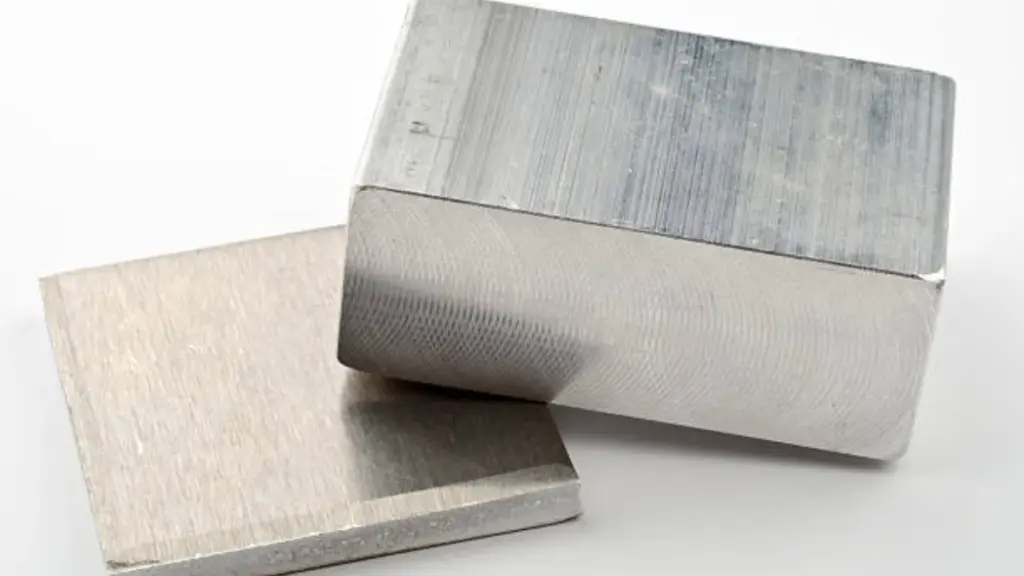
Aperçu du Zamak 5 Alliage
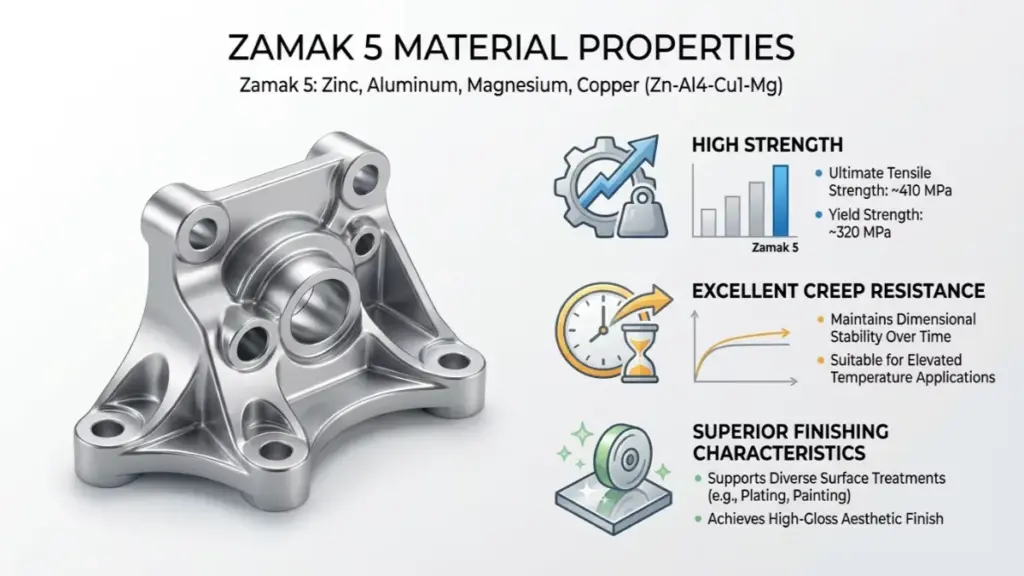
Le Zamak 5 est un alliage de moulage sous pression à base de zinc qui appartient à la famille des Zamak. (un acronyme pourZinc, Aluminium, Magnésium, et du cuivre, c'est-à-dire, cuivre) matériels. Il est bien connu pour sa combinaison de force, dureté, et un excellent comportement de finition de surface, ce qui le rend idéal pour les pièces décoratives et structurelles qui exigent précision et durabilité.
Composition chimique et propriétés
La formulation du Zamak 5 diffère légèrement des autres qualités de Zamak en raison de sa teneur plus élevée en cuivre., ce qui améliore la dureté et la résistance. La composition typique est présentée ci-dessous:
| Élément | Contenu (%) |
|---|---|
| Zinc (Zn) | Équilibre |
| Aluminium (Al) | 3.5 – 4.3 |
| Cuivre (Cu) | 0.75 – 1.25 |
| Magnésium (Mg) | 0.03 – 0.06 |
| Fer (Fe) | < 0.075 |
| Plomb (Pb) | < 0.005 |
| Cadmium (CD) | < 0.004 |
La différence entre le Zamak 3 et Zamak 5 réside principalement dans le pourcentage de cuivre. Tandis que le Zamak 3 contient un minimum de cuivre, Charges 5 comprend près de 1%, ce qui augmente considérablement la résistance à la traction et la dureté mais réduit légèrement la ductilité.
Propriétés mécaniques et physiques
| Propriété | Charges 5 Valeur typique |
|---|---|
| Résistance à la traction | ~331 MPa |
| Limite d'élasticité | ~260 MPa |
| Élongation | ~7% |
| Dureté (Brinell) | 91 HB |
| Densité | 6.6 – 6.7 g / cm³ |
| Plage de fusion | 380 – 386°C |
| Conductivité thermique | 109 W / m · k |
| Conductivité électrique | 27% SIGC |
Ces caractéristiques font du zinc Zamak 5 un choix privilégié pour les pièces de précision de petite et moyenne taille qui nécessitent une stabilité dimensionnelle et une excellente qualité de placage.. L'alliage supporte également des tolérances serrées, ce qui est précieux pour des applications telles que les boîtiers mécaniques ou les raccords décoratifs.
Présentation des alliages d'aluminium moulés sous pression (ADC12 / A380)
Alors que Alliages Zamak dominer le moulage à base de zinc, alliages d'aluminium tels que l'ADC12(utilisé principalement en Asie) et A380(commun en Amérique du Nord et en Europe) représentent les matériaux dominants dans le moulage sous pression d'aluminium. Leur légèreté et leurs performances thermiques les rendent idéales pour les composants plus grands ou exposés à la chaleur..
Composition et caractéristiques typiques
| Élément | ADC12 (%) | A380 (%) |
|---|---|---|
| Aluminium (Al) | Équilibre | Équilibre |
| Silicium (Et) | 9.6 – 12.0 | 7.5 – 9.5 |
| Cuivre (Cu) | 1.5 – 3.5 | 3.0 – 4.0 |
| Magnésium (Mg) | ≤ 0.3 | 0.1 |
| Fer (Fe) | ≤ 1.3 | ≤ 1.3 |
| Zinc (Zn) | ≤ 1.0 | ≤ 3.0 |
Propriétés mécaniques et physiques
| Propriété | ADC12 | A380 |
|---|---|---|
| Résistance à la traction | ~320 MPa | ~317 MPa |
| Limite d'élasticité | ~160 MPa | ~180 MPa |
| Élongation | ~1 – 2% | ~3,5% |
| Dureté (Brinell) | ~85 HB | ~80 HB |
| Densité | 2.7 g / cm³ | 2.7 g / cm³ |
| Conductivité thermique | 96 W / m · k | 96 W / m · k |
Les alliages d'aluminium équilibrent la résistance et le faible poids, offrant une fluidité exceptionnelle pour les géométries complexes tout en résistant à la distorsion thermique. Ces caractéristiques sont essentielles pour les industries automobile et électronique où la réduction du poids et la gestion de la chaleur déterminent le choix des matériaux..
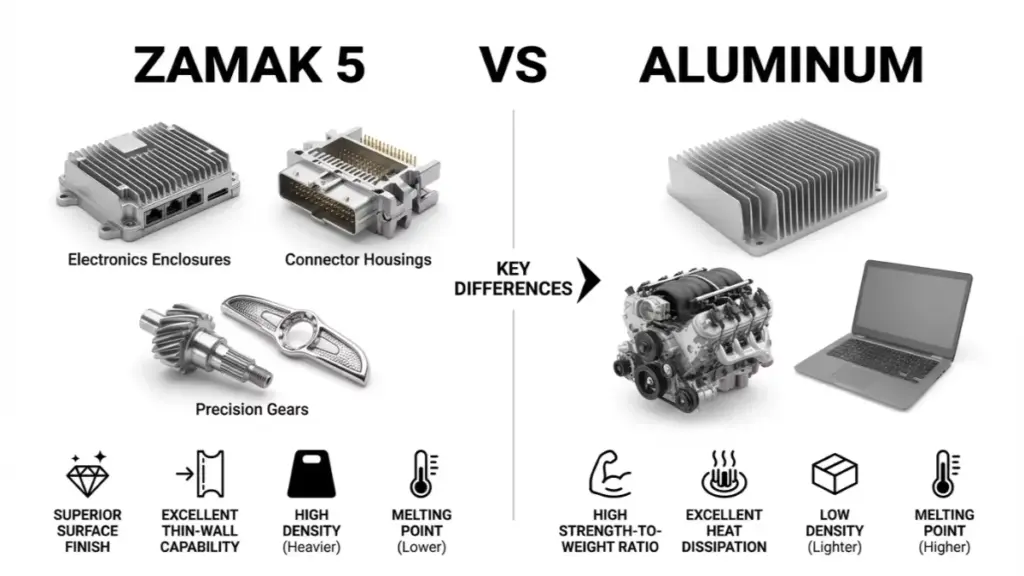
Charges 5 contre. Alliages d'aluminium – Comparaison des propriétés
Les sections suivantes mettent en évidence les principales différences entre le zinc Zamak 5 et les alliages de fonderie d'aluminium en matière de mécanique., physique, et dimensions de production.
Performances mécaniques et physiques
| Paramètre | Charges 5 | ADC12 / A380 | Aperçu clé |
|---|---|---|---|
| Résistance à la traction | ~331 MPa | ~320 MPa | Résistance comparable; Charges 5 offre une meilleure dureté. |
| Dureté | 91 HB | 80–85 HB | Charges 5 les pièces résistent plus efficacement à l’usure et aux contraintes mécaniques. |
| Élongation | ~7% | 1–3% | L'aluminium est plus fragile; Charges 5 permet une légère déformation avant rupture. |
| Densité | 6.6–6,7 g/cm³ | 2.7 g / cm³ | Les pièces en aluminium sont d'environ 60% plus léger. |
Charges 5 présente une précision dimensionnelle et une dureté plus élevées, ce qui le rend idéal pour les pièces où la précision et la résistance dans une petite taille sont essentielles, comme des loquets ou des engrenages. Aluminium, d'autre part, est favorisé là où la réduction du poids et la gestion thermique prédominent.
Résistance à la corrosion et finition de surface
Le zinc résiste naturellement à la corrosion grâce à sa couche d'oxyde stable, donnant au zinc Zamak 5 de fortes performances dans des conditions humides ou oxydantes. En plus, Charges 5 supporte facilement la galvanoplastie, peinture, et chromatation.
L'aluminium offre une bonne résistance à la corrosion mais nécessite des traitements de surface tels que l'anodisation ou le revêtement en poudre pour améliorer la durabilité et l'apparence.. Il est particulièrement adapté aux composants structurels extérieurs.
| Aspect | Charges 5 | Aluminium (ADC12 / A380) |
|---|---|---|
| Résistance naturelle à la corrosion | Excellent | Bien |
| Placage / Peinture | Supérieur (finition miroir possible) | Bien (anodisation préférée) |
| Applications esthétiques | Excellent | Modéré |
| Durabilité environnementale | Haut | Haut (après revêtement) |
Caractéristiques de coulée et de production
Une autre distinction cruciale est le comportement de casting. Le Zinc Zamak 5 fond à une température plus basse (autour de 385°C contre. l'aluminium ~660°C), ce qui entraîne une consommation d’énergie inférieure, temps de cycle plus courts, et durée de vie prolongée du moule.
Cependant, Les alliages Zamak sont plus denses et moins adaptés aux grandes pièces en raison de leur poids et du coût plus élevé du matériau par volume..
| Paramètre | Charges 5 | Aluminium ADC12 / A380 |
|---|---|---|
| Température de fusion | ~385°C | ~660°C |
| Temps de cycle | Plus court | Modéré |
| Durée de vie du moule | Plus long | Plus court |
| Taille de pièce appropriée | Petit à moyen | Moyen à grand |
| Stabilité dimensionnelle | Excellent | Bien |
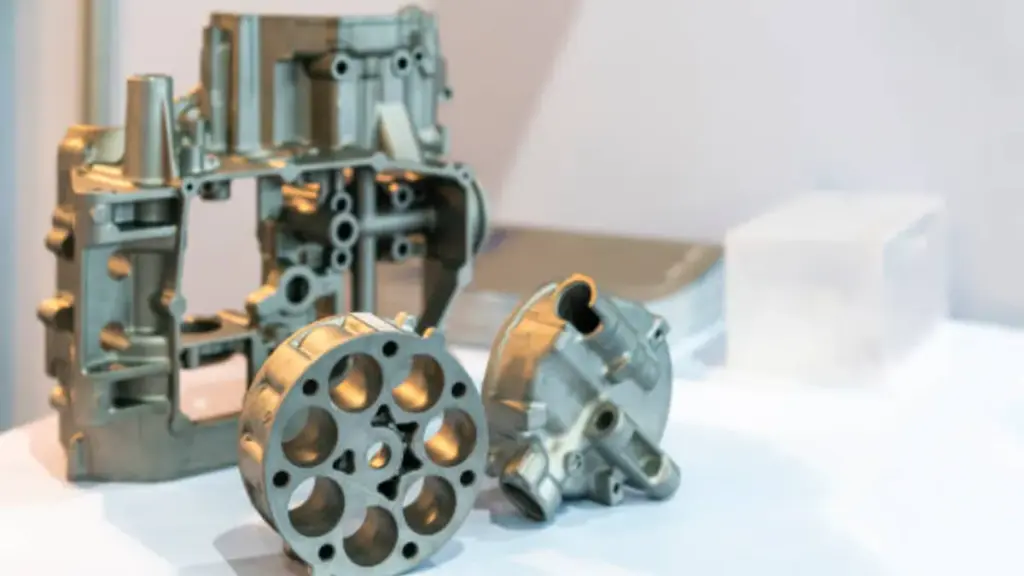
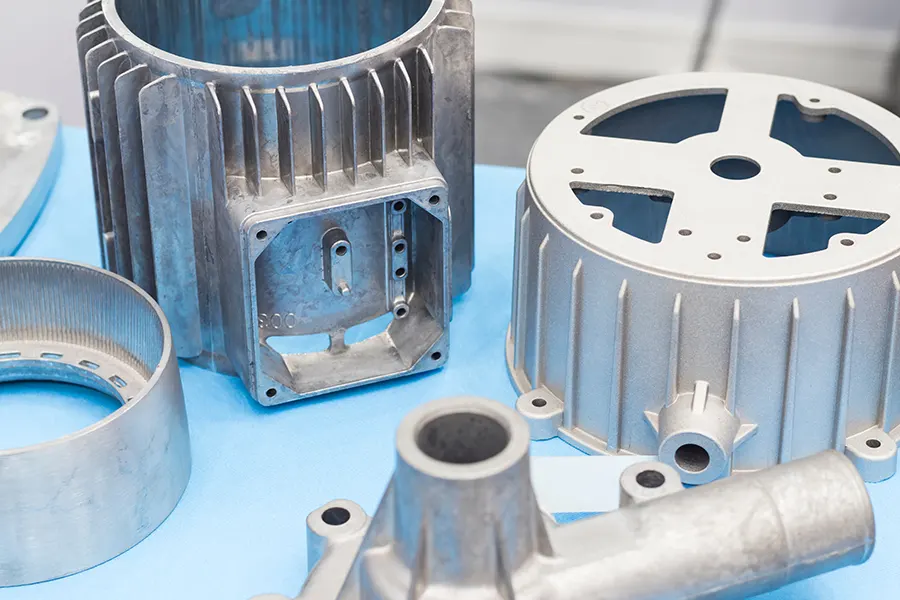
Moulage sous pression en Zamak prend en charge des parois minces et un contrôle précis des tolérances sans usinage secondaire, tandis que les matrices en aluminium supportent mieux les plus grandes, boîtiers ou cadres dissipateurs de chaleur.
Choisir le bon matériau pour votre application
Le « bon » choix entre Zamak 5 et l'aluminium dépend entièrement des objectifs de l'application.
Voici quelques facteurs directeurs à considérer:
- Taille et poids des composants:
- L'aluminium est préféré pour les structures plus grandes ou légères.
- Charges 5 fonctionne mieux pour les compacts, composants de précision.
- Exigences de résistance et de charge:
- Les deux alliages offrent de solides performances, mais Zamak 5 offre une dureté et une résistance à l'usure supérieures dans les petits mécanismes.
- Esthétique des surfaces:
- Pour les produits nécessitant des finitions décoratives en chrome ou en peinture (par ex., poignées, luminaires), Charges 5 surpasse généralement l'aluminium.
- Besoins thermiques et électriques:
- L'aluminium gagne là où la conductivité et la dissipation thermique comptent (par ex., boîtiers moteur ou électronique).
- Efficacité et coût de production:
- Les alliages de zinc offrent une durée de vie des outils plus longue et des cycles plus rapides.
- La densité de matériau plus faible de l’aluminium réduit souvent le coût par pièce lorsque de grands volumes sont nécessaires.
En substance, Charges 5 remplit le créneau de la haute précision, petites pièces métalliques, tandis que les alliages d'aluminium restent la norme de l'industrie pour les grands, pièces moulées légères.
L'expertise de BIAN dans les solutions de moulage sous pression
Avec des années d'expérience technique dans le moulage sous pression d'aluminium, BIEN fournit un support technique complet, de la conception du moule et de la sélection des alliages au traitement de surface et à l'assemblage final.
Notre équipe d’ingénieurs maîtrise le travail avec une variété d’alliages, y compris le zinc Zamak 5 et les qualités d'aluminium comme ADC12 et A380, garantir que les clients reçoivent des conseils objectifs et spécifiques à l'application.
Conclusion
La comparaison entre le Zamak 5 et les alliages d'aluminium moulés sous pression met en évidence que les deux présentent des avantages uniques.:
- Zamak 5 offre une finition de surface supérieure, dureté, et tolérance pour les conceptions complexes.
- Les alliages d'aluminium apportent de la légèreté, efficacité thermique, et rentabilité pour les composants à grande échelle.
Plutôt qu'une concurrence directe, ces alliages se complètent pour répondre à différents besoins d'ingénierie.
Le rôle de BIAN est d'aider les clients à faire face à ces choix grâce à des informations basées sur les données et une expertise technique., s'assurer que le produit final atteint le meilleur équilibre entre l'intention de conception, performance, et l'efficacité de la production.