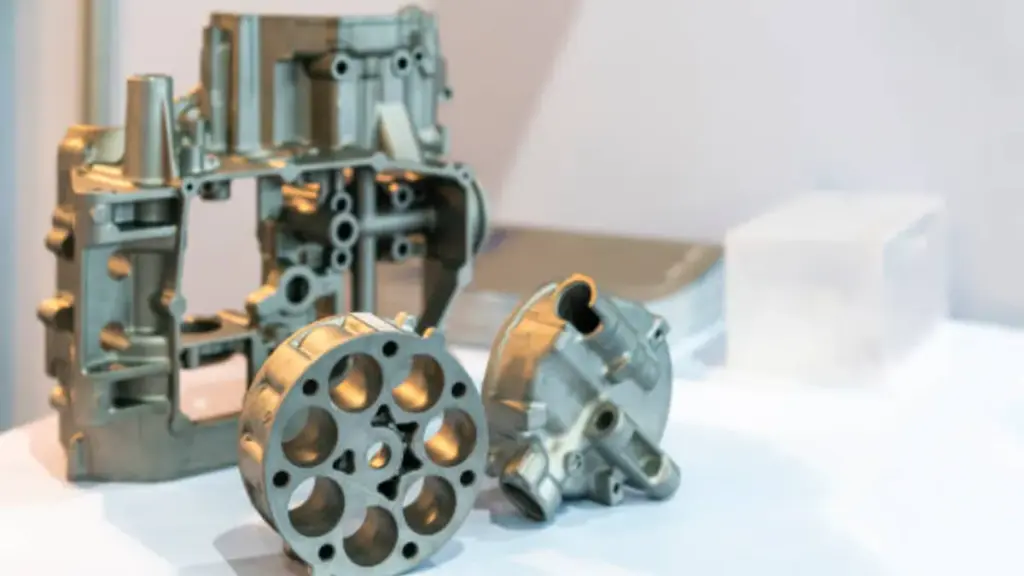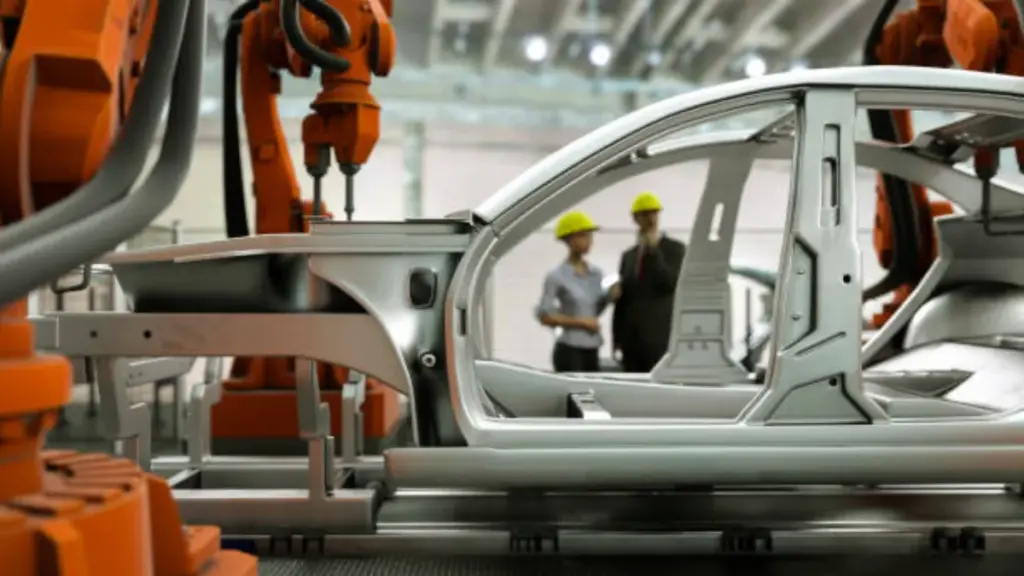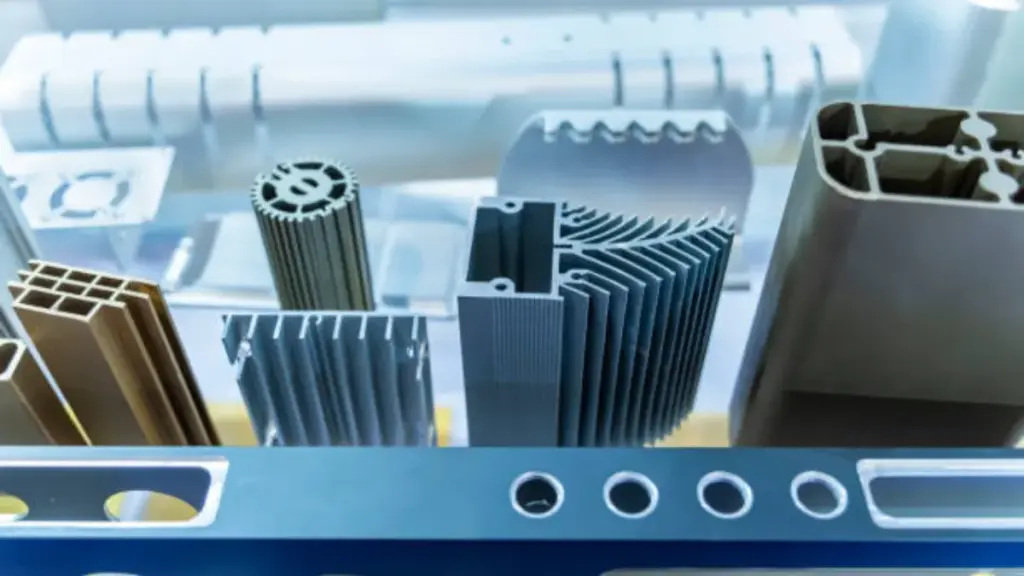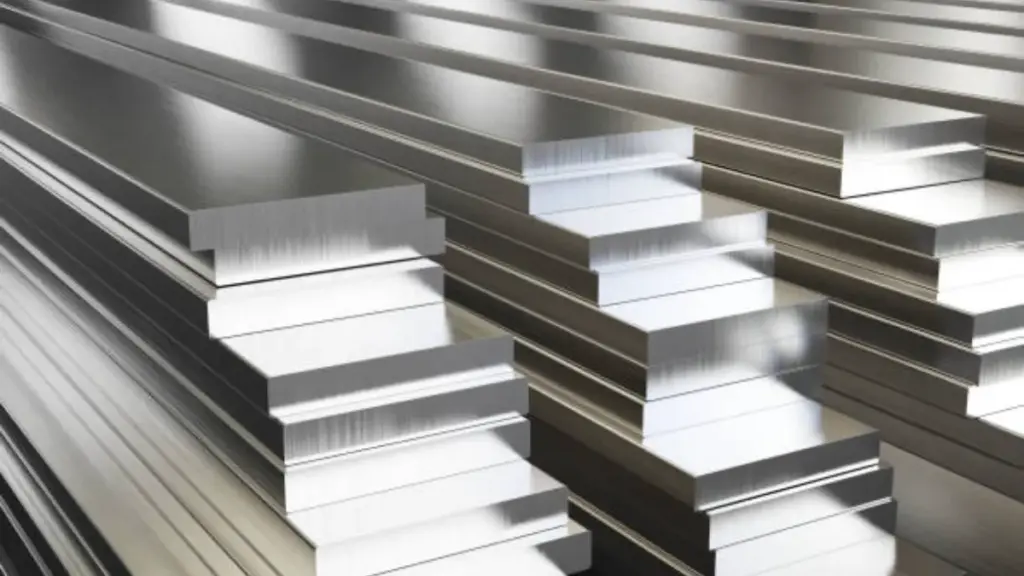
Las diferentes aleaciones ofrecen combinaciones únicas de rendimiento mecánico, costo, y capacidad de fabricación. Entre varias opciones, El zinc Zamak 5 y las aleaciones de aluminio como ADC12 y A380 son dos de los materiales más comunes en aplicaciones industriales..
Este artículo proporciona una visión profunda, visión objetiva del zamak 5 propiedades del material, lo compara con los materiales típicos de fundición a presión de aluminio, y explora dónde cada aleación funciona mejor.
Descripción general del zamak 5 Aleación
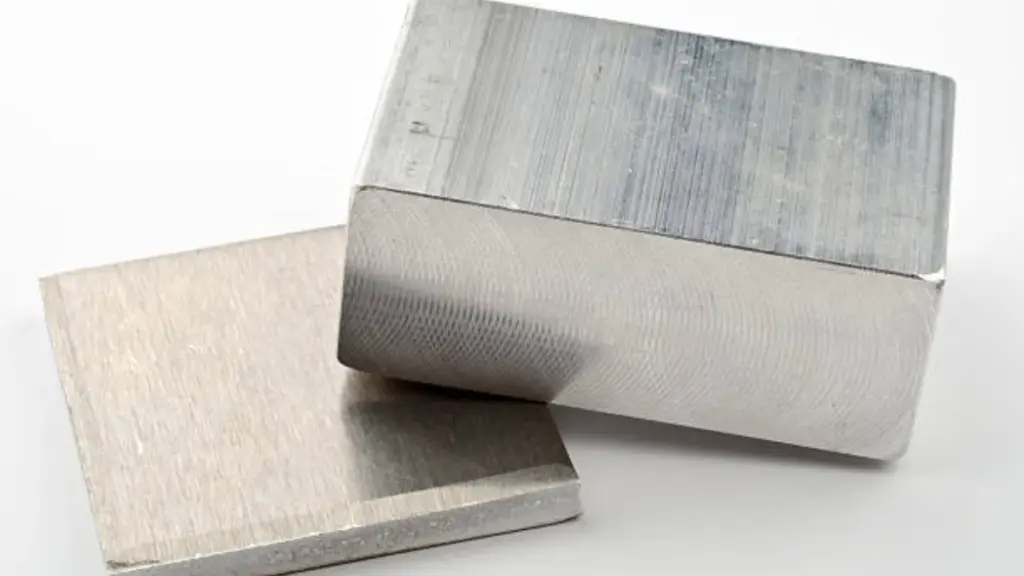
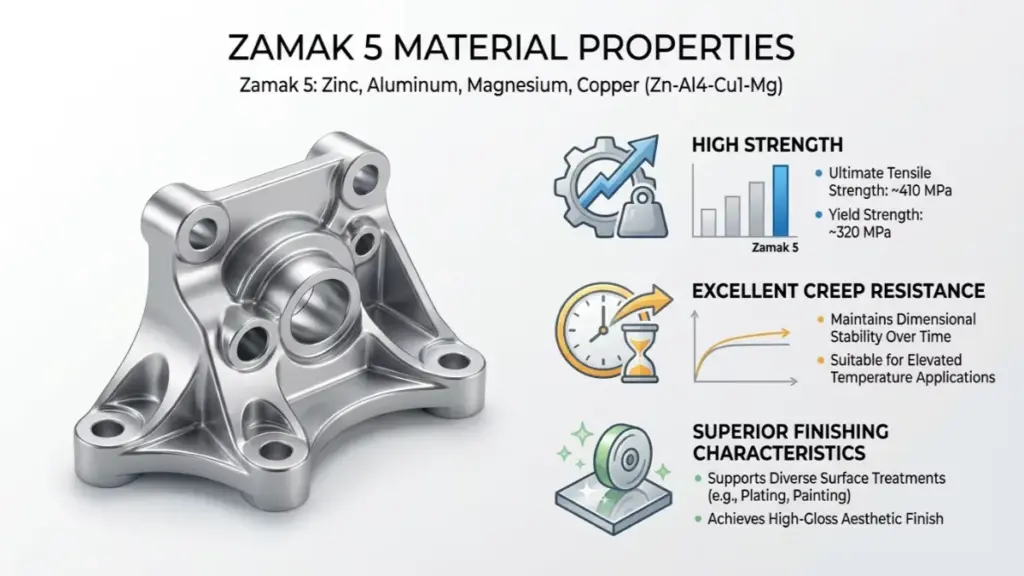
Zamak 5 es una aleación de fundición a presión a base de zinc que pertenece a la familia del Zamak. (un acrónimo paraZinc, Aluminio, Magnesio, y cobre, es decir., cobre) materiales. Es bien conocido por su combinación de fuerza., dureza, y excelente comportamiento de acabado superficial, haciéndolo ideal para piezas decorativas y estructurales que exigen precisión y durabilidad..
Composición y propiedades químicas.
La formulación de Zamak 5 se diferencia ligeramente de otros grados de Zamak por su mayor contenido en cobre., que mejora la dureza y la resistencia. La composición típica se muestra a continuación.:
| Elemento | Contenido (%) |
|---|---|
| Zinc (zinc) | Balance |
| Aluminio (Alabama) | 3.5 – 4.3 |
| Cobre (Cu) | 0.75 – 1.25 |
| Magnesio (magnesio) | 0.03 – 0.06 |
| Hierro (fe) | < 0.075 |
| Dirigir (Pb) | < 0.005 |
| Cadmio (Cd) | < 0.004 |
La diferencia entre Zamak 3 y Zamak 5 reside principalmente en el porcentaje de cobre. Mientras que el zamak 3 contiene un mínimo de cobre, las cargas 5 incluye casi 1%, que aumenta significativamente la resistencia a la tracción y la dureza pero reduce ligeramente la ductilidad.
Propiedades mecánicas y físicas
| Propiedad | las cargas 5 Valor típico |
|---|---|
| Resistencia a la tracción | ~331MPa |
| Fuerza de producción | ~260MPa |
| Alargamiento | ~7% |
| Dureza (Brinell) | 91 media pensión |
| Densidad | 6.6 – 6.7 g/cm³ |
| Rango de fusión | 380 – 386°C |
| Conductividad térmica | 109 W/m · k |
| Conductividad eléctrica | 27% SIGC |
Estas características hacen del zinc Zamak 5 la opción preferida para piezas de precisión de tamaño pequeño y mediano que necesitan estabilidad dimensional y excelente calidad de revestimiento.. La aleación también admite tolerancias estrictas., Lo cual es valioso para aplicaciones como carcasas mecánicas o accesorios decorativos..
Descripción general de las aleaciones de fundición a presión de aluminio (ADC12 / A380)
Mientras Aleaciones de zamak Dominar la fundición a base de zinc., aleaciones de aluminio como ADC12(utilizado principalmente en Asia) y A380(común en América del Norte y Europa) Representan los materiales principales en la fundición a presión de aluminio.. Su ligereza y rendimiento térmico los hacen ideales para componentes más grandes o expuestos al calor..
Composición y características típicas
| Elemento | ADC12 (%) | A380 (%) |
|---|---|---|
| Aluminio (Alabama) | Balance | Balance |
| Silicio (Y) | 9.6 – 12.0 | 7.5 – 9.5 |
| Cobre (Cu) | 1.5 – 3.5 | 3.0 – 4.0 |
| Magnesio (magnesio) | ≤ 0.3 | 0.1 |
| Hierro (fe) | ≤ 1.3 | ≤ 1.3 |
| Zinc (zinc) | ≤ 1.0 | ≤ 3.0 |
Propiedades mecánicas y físicas
| Propiedad | ADC12 | A380 |
|---|---|---|
| Resistencia a la tracción | ~320MPa | ~317MPa |
| Fuerza de producción | ~160MPa | ~180MPa |
| Alargamiento | ~1 – 2% | ~3,5% |
| Dureza (Brinell) | ~85 HB | ~80 HB |
| Densidad | 2.7 g/cm³ | 2.7 g/cm³ |
| Conductividad térmica | 96 W/m · k | 96 W/m · k |
Las aleaciones de aluminio equilibran resistencia y bajo peso., Ofrece una fluidez excepcional para geometrías complejas y resiste la distorsión térmica.. Estas características son fundamentales para las industrias automotriz y electrónica donde la reducción de peso y la gestión del calor impulsan la selección de materiales..
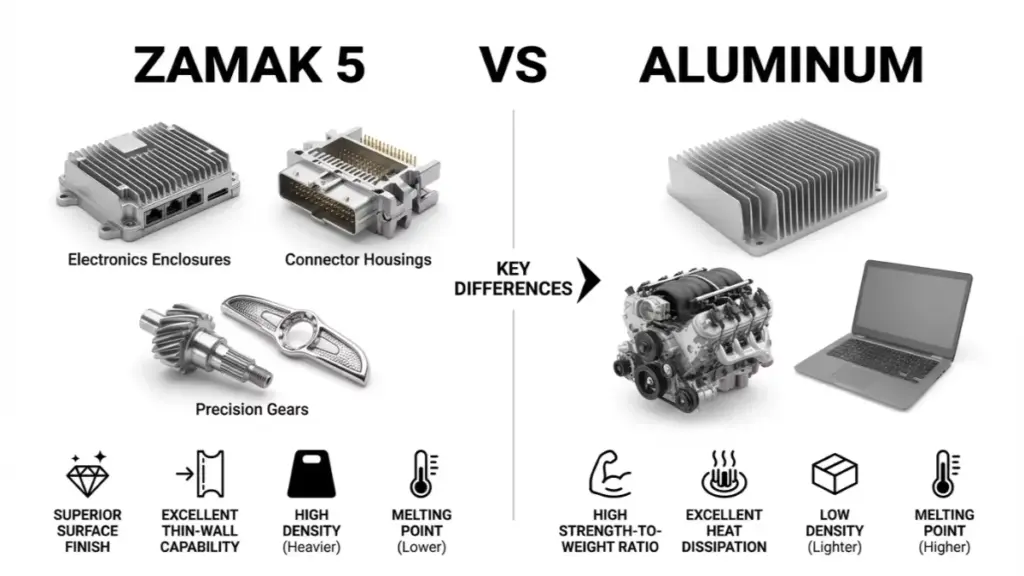
las cargas 5 vs. Aleaciones de aluminio: comparación de propiedades
Las siguientes secciones resaltan las diferencias clave entre el zinc Zamak 5 y las aleaciones de fundición de aluminio en términos mecánicos., físico, y dimensiones de producción.
Rendimiento mecánico y físico
| Parámetro | las cargas 5 | ADC12 / A380 | Información clave |
|---|---|---|---|
| Resistencia a la tracción | ~331MPa | ~320MPa | Fuerza comparable; las cargas 5 ofrece mejor dureza. |
| Dureza | 91 media pensión | 80–85 HB | las cargas 5 Las piezas resisten más eficazmente el desgaste y la tensión mecánica.. |
| Alargamiento | ~7% | 1–3% | El aluminio es más frágil.; las cargas 5 permite una ligera deformación antes de fallar. |
| Densidad | 6.6–6,7 g/cm³ | 2.7 g/cm³ | Las piezas de aluminio son aproximadamente 60% más ligero en peso. |
las cargas 5 exhibe mayor precisión dimensional y dureza, lo que lo hace ideal para piezas donde la precisión y la resistencia en un tamaño pequeño son clave, como pestillos o engranajes. Aluminio, por otro lado, Se favorece donde prevalecen la reducción de peso y la gestión térmica..
Resistencia a la corrosión y acabado superficial
El zinc resiste naturalmente la corrosión debido a su capa de óxido estable., dando al zinc Zamak 5 un fuerte rendimiento en condiciones húmedas u oxidantes. Además, las cargas 5 soporta fácilmente la galvanoplastia, cuadro, y cromato.
El aluminio proporciona una resistencia a la corrosión decente, pero requiere tratamientos superficiales como anodizado o recubrimiento en polvo para mejorar la durabilidad y la apariencia.. Es especialmente adecuado para componentes estructurales al aire libre..
| Aspecto | las cargas 5 | Aluminio (ADC12 / A380) |
|---|---|---|
| Resistencia a la corrosión natural | Excelente | Bien |
| Enchapado / Cuadro | Superior (acabado espejo posible) | Bien (anodizado preferido) |
| Aplicaciones estéticas | Excelente | Moderado |
| Durabilidad ambiental | Alto | Alto (después del recubrimiento) |
Características de fundición y producción.
Otra distinción crucial es el comportamiento de casting. Zinc Zamak 5 se funde a menor temperatura (alrededor de 385°C frente a. ~660°C del aluminio), lo que resulta en un menor consumo de energía, tiempos de ciclo más cortos, y vida útil prolongada del molde.
Sin embargo, Las aleaciones de Zamak son más densas y menos adecuadas para piezas grandes debido al peso y al mayor coste del material por volumen..
| Parámetro | las cargas 5 | Aluminio ADC12 / A380 |
|---|---|---|
| Temperatura de fusión | ~385°C | ~660°C |
| Tiempo de ciclo | más corto | Moderado |
| Vida del molde | Más extenso | más corto |
| Tamaño de pieza adecuado | Pequeño a mediano | Mediano a grande |
| Estabilidad dimensional | Excelente | Bien |
Fundición a presión de zamak admite paredes delgadas y control de tolerancia preciso sin mecanizado secundario, mientras que los troqueles de aluminio soportan mejor, carcasas o marcos disipadores de calor.
Elegir el material adecuado para su aplicación
La elección “correcta” entre Zamak 5 y el aluminio depende completamente de los objetivos de la aplicación..
Aquí hay algunos factores guía a considerar:
- Tamaño y peso del componente:
- Se prefiere el aluminio para estructuras más grandes o livianas..
- las cargas 5 funciona mejor para compacto, componentes diseñados con precisión.
- Requisitos de resistencia y carga:
- Ambas aleaciones ofrecen un gran rendimiento., pero zamak 5 Proporciona dureza superior y resistencia al desgaste en mecanismos pequeños..
- Estética de superficies:
- Para productos que requieren acabados decorativos en cromo o pintura. (p.ej., manijas, accesorios), las cargas 5 normalmente supera al aluminio.
- Necesidades Térmicas y Eléctricas:
- El aluminio gana donde la conductividad y la disipación de calor importan (p.ej., Carcasas de motor o electrónica.).
- Eficiencia y costo de producción:
- Las aleaciones de zinc ofrecen una mayor vida útil de las herramientas y ciclos más rápidos.
- La menor densidad del material del aluminio a menudo reduce el costo por pieza cuando se requieren grandes volúmenes.
En esencia, las cargas 5 llena el nicho de la alta precisión, pequeñas piezas de metal, mientras que las aleaciones de aluminio siguen siendo el estándar de la industria para grandes, piezas fundidas ligeras.
La experiencia de BIAN en soluciones de fundición a presión
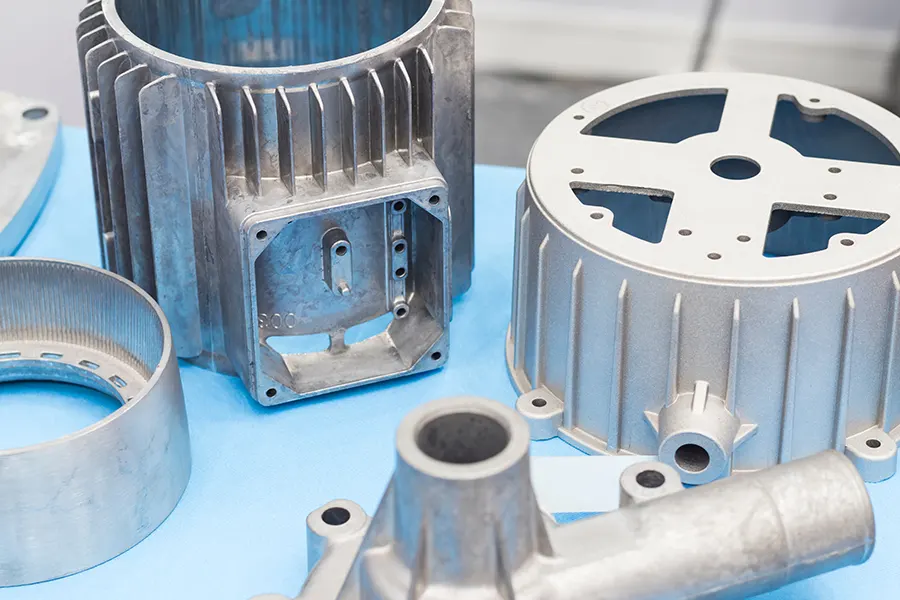
Con años de experiencia técnica en fundición a presión de aluminio., BIAN Proporciona soporte integral de ingeniería, desde el diseño de moldes y la selección de aleaciones hasta el tratamiento de superficies y el ensamblaje final..
Nuestro equipo de ingeniería es competente en trabajar con una variedad de aleaciones., incluyendo zinc Zamak 5 y grados de aluminio como ADC12 y A380, Garantizar que los clientes reciban asesoramiento sobre materiales objetivo y específico para cada aplicación..
Conclusión
La comparación entre Zamak 5 y las aleaciones de fundición a presión de aluminio destaca que ambas tienen ventajas únicas:
- Zamak 5 ofrece un acabado superficial superior, dureza, y tolerancia para diseños complejos.
- Las aleaciones de aluminio aportan ligereza, eficiencia térmica, y rentabilidad para componentes a gran escala.
Más que una competencia directa, Estas aleaciones se complementan entre sí en diferentes necesidades de ingeniería..
El papel de BIAN es ayudar a los clientes a navegar por estas opciones con conocimiento basado en datos y experiencia técnica., garantizar que el producto final logre el mejor equilibrio entre la intención del diseño, actuación, y eficiencia de producción.