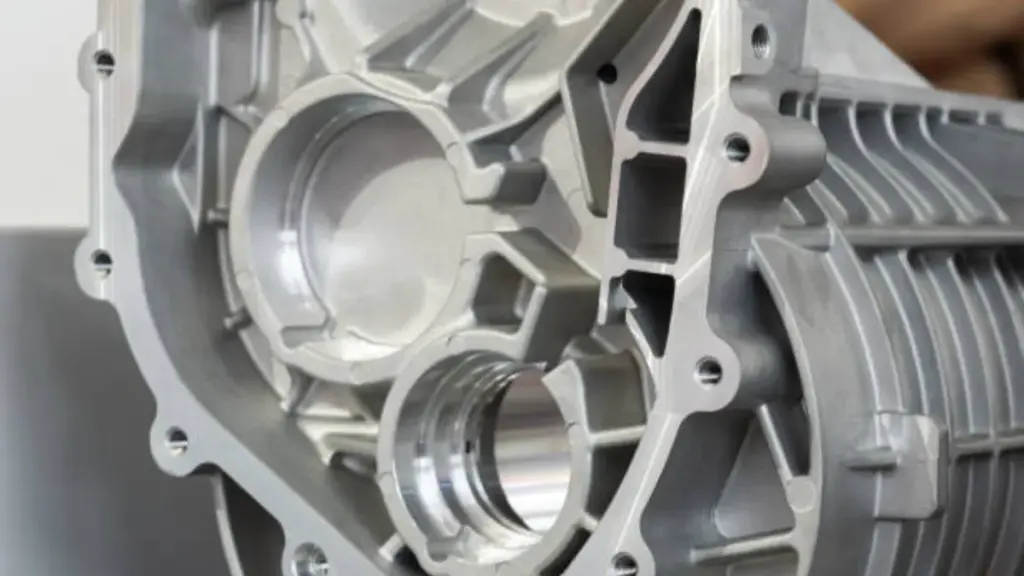
Two parts leave the same finishing area carrying the same corrosion callout. One came out of an e-coat tank. One came out from under a powder bell. They are not interchangeable, and the gap is not taste. The e-coating vs powder coating choice turns on geometry, film thickness, रंग, and how much dimension a machined housing can give to a finish. Get it wrong and you pay for a thick decorative film you did not need, or you find a spray cannot reach the inside of a cored cavity. This comparison shows where each finish wins on an aluminum die casting. It also shows what to write into a spec so a quote means the same thing to both sides.
How Each Finish Lays Down a Film
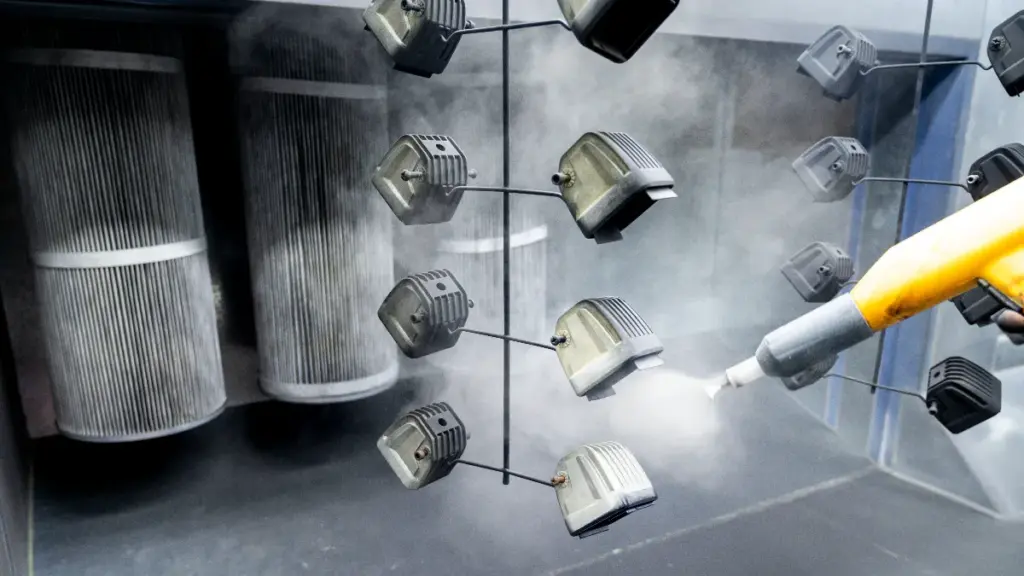
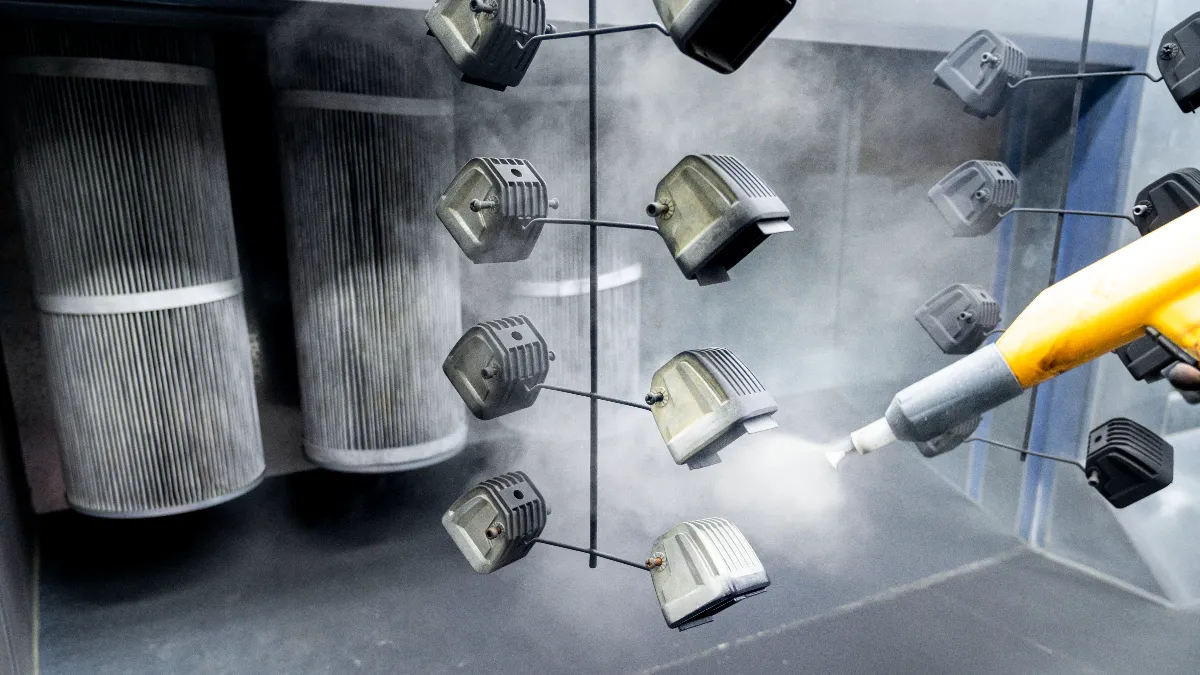
The two processes differ in one mechanic that drives everything else. Powder coating is a dry, line-of-sight process. An electrostatic charge holds air-blown powder to the grounded part. The part enters an oven, and the film melts and crosslinks into a continuous layer. Nothing requires electricity to find the surface. The gun aims, the powder travels, and the film lands where it was thrown. That single fact explains most of the process’s strengths and its blind spots.
E-coating is a wet, current-driven process. The part is immersed in a water-based bath holding charged resin and pigment. It becomes one electrode of a DC circuit. Coating deposits wherever current reaches, including blind bores and internal walls a spray could not see. The film also self-limits. As it thickens it resists further deposition, so build concentrates at bare spots and evens out across the part. Cathodic e-coat has been the automotive body primer standard since the late 1970s. Component suppliers inherited that line technology at die-casting scale.
Put simply, powder is applied by aim and e-coat is applied by current. Everything below follows from that line.
Where Each Process Earns Its Place
Buyers specify powder when the outside surface is the product. Outdoor lighting housings and automotive brackets are the classic cases. The film must take UV, stone chip, handling, and weather for years, and it must carry a color. Powder delivers a 60-120 micron layer with the full RAL range and textured options. It does that at production speed on parts that can hang on a conveyor and be sprayed directly. The ScienceDirect overview of powder coatings describes this same electrostatic, solvent-free film.
Buyers specify e-coat when geometry or tolerance is the problem. A housing with deep cored recesses is one case, and an assembly with mating faces is another. Those faces may need to stay within a few hundredths of a millimeter. Parts that need a corrosion primer everywhere electricity can reach get dipped. Production e-coat dry film is commonly held around 15-25 माइक्रोन. That is thinner and far more uniform than a typical powder coat, which is why threads and fits survive the finish. For the primer-side decision, this site’s guide to cathodic and anodic e-coating goes deeper.
The two also run in series rather than as rivals. An e-coat primer under a powder or wet topcoat is a legitimate system on castings that need total coverage plus a decorative exterior. It is worth pricing as a system before either single process gets ruled in or out. The powder coating process guide covers the topcoat line mechanics.
Film Thickness, Coverage, and Color
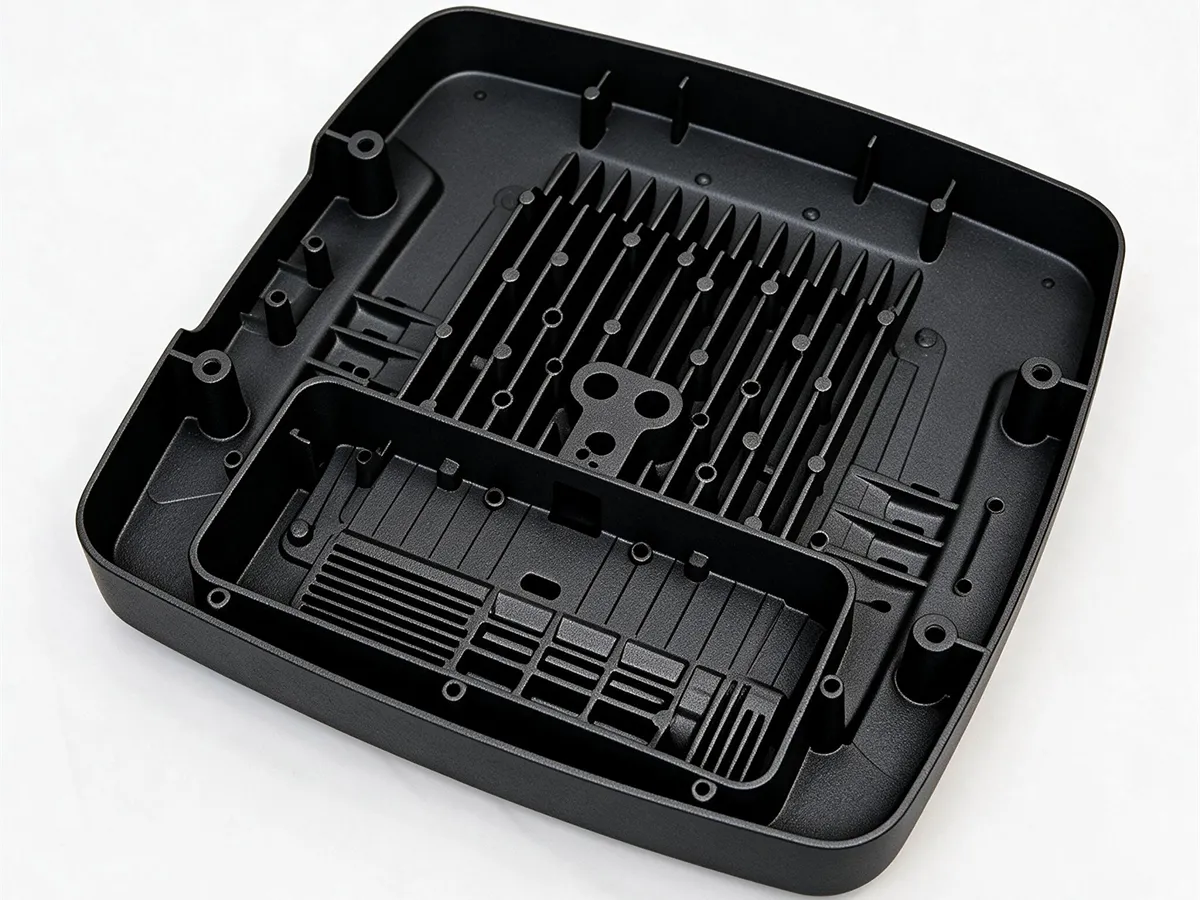
Thickness behaves in opposite ways in the two processes. A powder film is built by aiming more material at the surface. It wraps edges and can be tuned thick. The spec must read as a band with a measurement method, not a single number. An exterior specification such as Qualicoat Class 1 sets a minimum average film around 60 माइक्रोन. It also sets a single-point floor and names an eddy-current gauge method on aluminum. More is not safer. Over-thick powder risks under-cure and poor adhesion, and it can chip or peel from the substrate.
E-coat thickness is set by electrical conditions. Voltage, time, bath temperature, solids, and conductivity fix the build, and the self-limiting mechanism holds it tight at the micron scale. The trade-off is that a thin, even film clones the substrate. Every blast mark, polishing scratch, and as-cast skin defect you could bury under a powder coat stays visible under an e-coat. That is why the pre-coating surface operations have to be specified together with the finish, इसके बाद नहीं.
Color is where e-coat loses plainly. The workhorse cathodic epoxy chemistry is dark, and blacks and greys dominate. Pale or decorative colors mean an acrylic topcoat decision rather than an e-coat default. Powder owns the color and texture field outright.
Reading Corrosion Numbers Without Fooling Yourself
Both finishes get sold with salt-spray numbers, and both get sold with those numbers misread. ASTM B117 is a practice for operating a salt-fog apparatus. It standardizes the cabinet, not the prediction. The ScienceDirect overview of the salt-spray test treats it the same way, as an accelerated comparison rather than a service-life promise. A result of 500 hours B117 is a relative ranking between panels. It is not a warranty about how long a part lasts outdoors.
Two practical consequences follow for a buyer comparing e-coating vs powder coating. पहला, the corrosion result of either process is a system output. Pretreatment plus film weight together drive it, not the paint bag alone. A commercial e-coat tier near 96 hours B117 is common, और 240 को 600 hour tiers are standard engineering asks. A powder system can run beyond that, but scribe-creep and blistering criteria matter as much as the hours. Ask what test record supports the number, and request it in writing.
दूसरा, when the duty is genuinely corrosive, ask for a cyclic test. ASTM G85 or an acetic-salt-fog variant of ISO 9227 tracks real weathering better than a continuous fog. Write the hours and the pass criteria together on the drawing.
Note the adhesion scales too, because suppliers and buyers speak opposite dialects. Cross-cut ratings per ISO 2409 run 0 (श्रेष्ठ) को 5. ASTM D3359 runs 5B (श्रेष्ठ) to 0B. A supplier reporting class 0 and a buyer requiring 5B have, by accident, agreed. The two standards are similar but not technically equivalent, so name the standard on the drawing. The गुणवत्ता नियंत्रण पृष्ठ lists the film-thickness, आसंजन, and corrosion checks a supplier should be able to run.
The Two Finishes Compared Side by Side
The decision, compressed. Read each row as a reason to ask one more question at quotation time.
| Criterion | E-coat | Powder coat | What to pin down |
|---|---|---|---|
| Dry film | के बारे में 15-25 micron, self-leveling | के बारे में 60-120 micron typical band | Average plus single-point floor, gauge method |
| Internal coverage | Coats cavities by current | Line of sight, edge wrap-up | Which surfaces must be covered |
| Color and texture | Dark primers dominate | Full RAL range, textures | Decorative duty versus corrosion duty |
| Dimensional impact | Small; threads often survive | Significant on fits | Masking list on the drawing |
| Volume economics | Tank must keep running | Changeover is comparatively light | Run size and color count per order |
What Actually Drives the Cost
Nobody can quote either finish honestly from a part number alone. Prices move with alloy, ज्यामिति, and volume. What can be stated are the cost drivers each process punishes. E-coating punishes short runs and color variety. The bath is a tank that must keep running and be managed between colors, so exotic colors and tiny lots erode the economics that make the process attractive. It also punishes an unprepared substrate, because the thin film means blasting and polishing hours. That is why the finishing service scope is quoted as a chain, not as isolated steps.
Powder punishes geometry and tolerance. Shadows the bell cannot charge need fix-up passes or redesign. Thick films move fits, and masking adds labor per part. It also punishes vague durability asks. A 40-micron interior-grade polyester and a 120-micron architectural polyester cost differently and protect differently.
The comparison that saves money happens before tooling. Send the 3D model in STEP or a similar format. Ask the finishing engineer which surfaces the coating must reach and which must stay bare. A DFM conversation at quotation time costs a fraction of the same conversation after first articles come back wrong.
Confirming What Your Finisher Runs
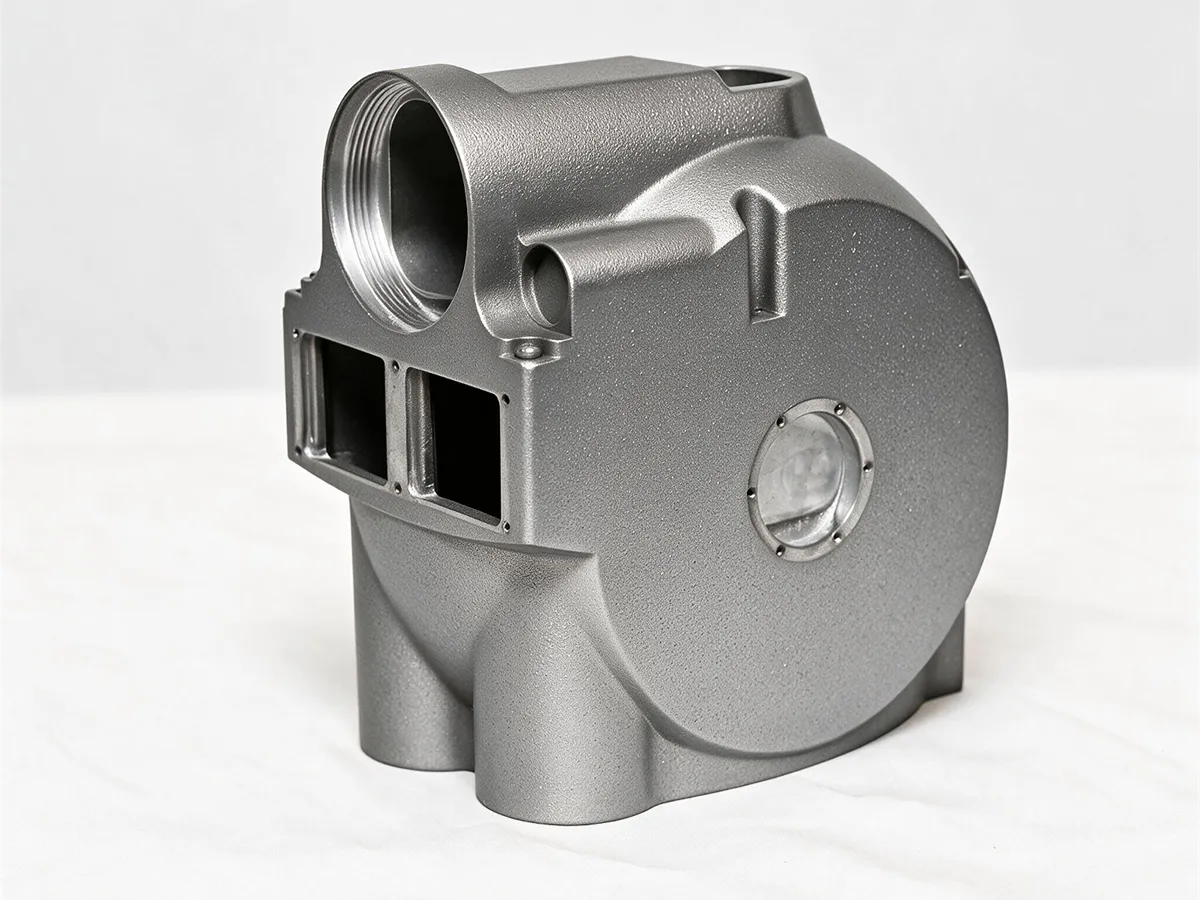
Read quotations correctly by asking one structural question. Does the shop run the coating step in-house, or route it through a partner line? The answer changes lead time, minimums, and who owns a defect. On this site, the surface finishing scope lists powder coating, lacquer, घर्षण, and shot and sand blasting as offered services. Anodizing appears there too, and e-coating is handled as part of the coating scope rather than as a separate supplier you must manage yourself.
What that structure asks of you is timing, not paperwork. Bring the geometry early, because pretreatment selection, edge behavior, and masking are decided with drawings, not at the tank. A finished-part drawing sent to the संपर्क पृष्ठ gets a routing answer in the first reply. That answer should say in-house powder, a partner e-coat line, or a primer-plus-topcoat system.
How to Write the Coating Spec
A callout that survives a dispute names the process, the film band, the test, and the mask. “Coated black” is a wish, कोई विशिष्टता नहीं. Write the type, the thickness band with a measurement method, the adhesion scale, and the corrosion test with hours and pass criteria together. List the surfaces that must stay bare, and note the bake envelope the part can survive.
Then decide the finish family against the part, not the catalog. If the part must be an insulator or a bearing surface, a coating may be the wrong tool. Anodizing converts the surface to oxide instead of adding a film, और this guide to anodized die castings explains where that path fits. For e-coating vs powder coating, the film math above is the tie-breaker.
अंतिम विचार
The e-coating vs powder coating decision is a coverage-and-thickness decision wearing a paint label. Powder wins on exterior durability, रंग, and edge build. E-coat wins on internal coverage, tight thin films, and parts that must stay in tolerance. Many castings want both, dipped first and topcoated second.
Pin the numbers down at quotation time. Name the standard, the band, the test, and the mask, and ask which surfaces must stay bare. That single spec turns two lookalike finishes into a decision you can defend.
Questions About E-Coating vs Powder Coating
Is e-coating or powder coating better for aluminum die castings?
Powder coating fits exterior durability, रंग, and mechanical protection at 60-120 माइक्रोन. E-coating fits full coverage of complex internal geometry at 15-25 microns with tight thickness control. If the part has deep cavities or threads that must stay functional, e-coat is usually the right primer. If the part faces weather and handling, powder is the right top layer.
Can e-coating and powder coating be combined?
हाँ. A cathodic e-coat primer followed by a powder or wet topcoat is a recognized system on castings that need coverage everywhere plus a decorative exterior. Price it as a two-stage system and confirm the topcoat window. The second coat must land within the primer’s recoat interval, or adhesion has to be re-verified.
Why is e-coating usually black or grey?
The dominant cathodic epoxy primer chemistry is pigmented dark, and pale colors are genuinely hard to hold in a recirculating bath with tight chemistry limits. A light or decorative color is an acrylic e-coat topcoat decision, or a powder coat. It is not an e-coat primer default.
What should a coating specification include before a quote?
A usable spec carries six items. Name the part alloy and casting grade, then the test standard with hours and pass criteria together. State the film band with a single-point floor and gauge method. List the surfaces that must stay bare, the bake envelope the part can survive, and the pre-coating surface quality. The adhesion standard on the drawing should say ISO 2409 or ASTM D3359, because the two scales run in opposite directions.