>

AlSi10Mgの材料特性: 精密ダイカストのテクニカルガイド

AlSi10Mgの材料特性: 精密ダイカストのテクニカルガイド

目次

Specifying alsi10mg for high-stress automotive and aerospace components dictates the line between structural integrity and catastrophic failure under thermal cycling. Relying on inadequate elemental balances forces heavier design choices, which increases cycle times and drives up tooling reject rates.

This analysis benchmarks standard structural alloys to establish clear manufacturing thresholds. We evaluate yield strength outputs between 165 そして 200 MPa and exact 2.67 g/cc density metrics to help you engineer defect-free, lightweight parts capable of surviving extreme load-bearing demands.

Introduction to AlSi10Mg

AlSi10Mg is a lightweight, high-strength aluminum alloy combining 10% silicon and 0.35% マグネシウム. It dominates 3D printing and precision die casting by balancing excellent fluidity with strong mechanical performance.

Chemical Composition and Alloying Elements

Manufacturers rely on an aluminum matrix saturated with specific alloying elements to control the material’s final behavior. Each element plays a distinct role in shaping the alloy’s processability and structural integrity.

  • シリコン (9-11%): Lowers the melting range and boosts fluidity, enabling defect-free casting and efficient 3D printing.
  • マグネシウム (~0.35%): Enables precipitation hardening through the formation of Mg2Si, directly increasing the overall strength of the finished part.
  • Manganese and Titanium (Trace): Act as grain refiners and modify iron phases to prevent brittle microstructures.

Physical and Mechanical Properties

Engineers select AlSi10Mg to hit aggressive weight reduction targets without sacrificing structural stability. The material features a low density of 2.68 g/cm³ and a melting range between 570 and 610°C, offering a distinct advantage over heavier ferrous alternatives.

The mechanical behavior shifts entirely based on your chosen processing state. As-printed parts deliver higher raw tensile strength right out of the machine. 逆に, applying a post-build heat treatment prioritizes ductility, giving you increased elongation before failure.

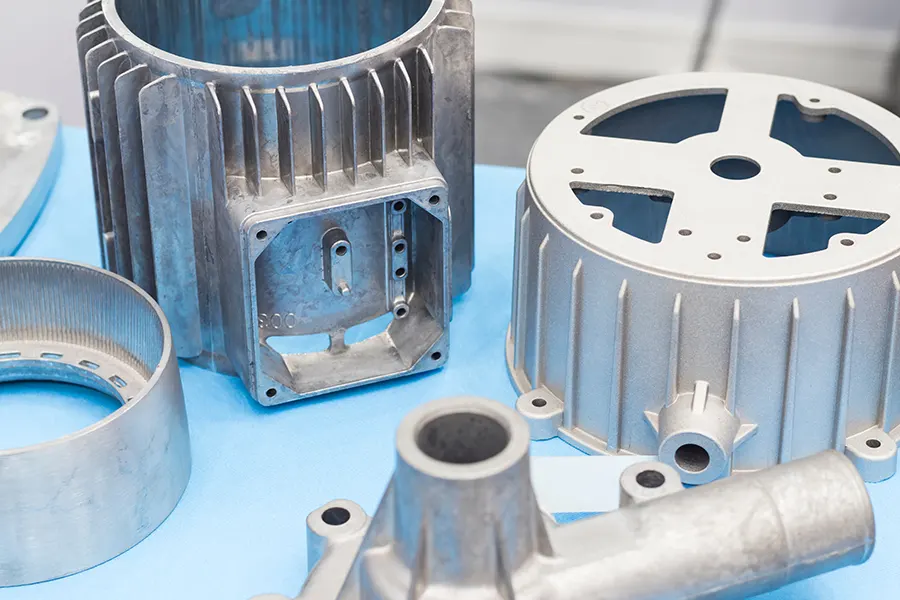
Strong thermal conductivity and inherent corrosion resistance equip the alloy for demanding operational environments. Manufacturers frequently use this material to build high-performance heat sinks, engine manifolds, and complex structural components that require efficient heat dissipation.

Key AlSi10Mg Material Properties for High-Stress Parts

AlSi10Mg balances 9-11% silicon and 0.2-0.45% magnesium to deliver high strength-to-weight ratios and thermal stability, making it ideal for structural automotive and aerospace load management.

財産 代表値 Structural Benefit
降伏強さ 165 – 200 MPa High dynamic load-bearing capacity
極限引張強さ 280 – 460 MPa Endurance against mechanical failure
密度 2.67 g/cc Significant component weight reduction
熱伝導率 170 w/m・k Withstands extreme thermal cycling

Chemical Composition Limits

AlSi10Mg relies on a precise elemental balance to perform in demanding environments. Metallurgists start with an aluminum base and mix in 9-11% silicon alongside 0.2-0.45% マグネシウム. This specific combination yields excellent castability, allowing manufacturers to fill thin walls and replicate complex geometries without creating structural weak points.

Maintaining these strict composition limits ensures a high strength-to-weight ratio. The alloy’s density remains significantly lower than competing ferrous, ニッケル, or titanium alloys. This exact elemental control allows structural automotive and aerospace components to handle high-stress load management while meeting rigorous 2026 industry standards.

機械的および物理的特性

Engineers specify AlSi10Mg primarily for its predictable mechanical performance under stress. The material delivers key physical advantages for heavy-duty applications:

  • Yield and Tensile Strength: Yield strength ranges from 165 に 200 MPa, and ultimate tensile strength hits 280 に 460 MPa. These outputs shift based on build orientation and specific heat treatments.
  • 密度: At just 2.67 g/cc, the material dramatically reduces component weight. This low mass supports high-load endurance for heavy engine parts and aerospace air ducting.
  • Anisotropy Control: Applying a stress relief cycle at 270°C or a solution treatment at 550°C significantly drops anisotropy. This allows operators to precisely tune both the hardness and the dynamic load-bearing capacity of the final part.

Thermal and Electrical Characteristics

AlSi10Mg handles rapid temperature shifts with minimal physical deformation. The alloy sustains a thermal conductivity of 170 W/m·K and features a melting range around 570°C. These thermal capabilities enable the material to survive extreme high-stress thermal cycling inside engine compartments and exhaust environments.

A coefficient of thermal expansion of 2.0 x 10^-5 K^-1 (between 0 and 100°C) keeps parts dimensionally stable when operating temperatures fluctuate. You can also apply targeted heat treatments to reliably increase electrical conductivity. These thermal processes preserve the core properties necessary for manufacturing gas-tight die-casting inserts.

Reduce Costs With Engineering-Driven Die Casting

Streamline your supply chain with our fully integrated, IATF 16949-certified die casting and CNC machining services. We deliver defect-free, high-volume metal components that significantly lower your total landed costs.

ダイカスト ソリューションを詳しく見る →

CTA画像

Comparing Aluminum Alloys: AlSi10Mg vs Alternatives

AlSi10Mg dominates 3D printing with unmatched fluidity, while Al6061, Al7075, and Al2024-RAM2C serve specialized roles demanding extreme strength, post-weldability, or marine-grade corrosion resistance.

AlSi10Mg vs. Traditional Structural Alloys (Al6061 and Al7075)

AlSi10Mg sets the standard for additive manufacturing thanks to its fine-grained microstructure. This structure delivers superior 3D printing fluidity and high fatigue strength. When you compare it to Al6061, the trade-offs become visible. Al6061 sacrifices some printability to offer better ductility and outstanding marine-grade corrosion resistance. Manufacturers typically choose Al6061 when post-print machining and weldability outweigh the need for complex internal geometries.

Moving up the strength tier, Al7075 provides the highest strength-to-weight ratio among commercial aluminum alloys. It easily handles extreme load-bearing tasks for aerospace and heavy industry. But Al7075 struggles heavily with 3D printability and falls victim to stress corrosion. If your design requires intricate components built via additive manufacturing, AlSi10Mg stands out as the highly printable and reliable choice.

AlSi10Mg vs. Advanced Additive Manufacturing Alloys (Al2024-RAM2C)

Recent shifts in reactive additive manufacturing introduced novel alloys like Al2024-RAM2C. This advanced material exceeds AlSi10Mg in both tensile strength and axial fatigue limits. High-performance sectors like aerospace and motorsport utilize it specifically to handle extreme axial stresses that standard alloys cannot survive.

Even with the advanced performance of Al2024-RAM2C, AlSi10Mg retains a noticeable advantage in impact toughness. It also requires significantly less process optimization to achieve a reliable print. Engineers working with Al2024-RAM2C must perform rigorous parameter tuning and microscopy validation. 対照的に, AlSi10Mg offers a proven, forgiving processing window for rapid and consistent production.

Best Practices for Precision Die Casting

Precision die casting demands strict control over part geometry, temperature regulation, and proactive tool maintenance to minimize defects and maximize production efficiency.

Optimizing Component Geometry

Getting the geometry right from the start dictates the success of your die casting run. Poorly designed features force molten metal into unnatural flow patterns, causing porosity, thermal stress, and increased cycle times.

  • Uniform Wall Thickness: Maintain 1.5-2.5 mm for aluminum and 1.0-2.0 mm for zinc to improve metal flow and cut porosity.
  • 抜き勾配角度: Apply at least 1° on external walls and 2° on internal cavities to prevent part sticking and ejection damage.
  • Corner Radii: Design internal fillets with a minimum 0.75 mm radius to speed up cavity filling and drop cracking risks.

Sharp corners and abrupt section changes create turbulence and irregular cooling. Following these precise dimensional limits ensures the metal feeds smoothly and solidifies predictably.

Process Control and Tooling Maintenance

Even the best geometries fail if process parameters drift. Consistent output relies on rigid thermal management, predictive analysis, and aggressive tooling upkeep.

  • Temperature Regulation: Monitor production temperatures constantly using embedded thermocouples to maximize equipment efficiency and avoid thermal stress on the dies.
  • Tooling Upkeep: Execute scheduled maintenance programs to clean die residues and lubricate moving components, drastically cutting overall downtime.
  • Predictive Simulation: Run simulation software to identify filling patterns, air entrapment, and solidification behavior before you start the full production run.

Fixing defects on the shop floor eats into your margins. Simulating the pour first, combined with strict maintenance and thermal tracking, keeps your reject rates near zero and extends the lifespan of your tooling.

よくある質問

What are the main advantages of AlSi10Mg in die casting?

AlSi10Mg offers exceptional castability due to its 9.0–11.0% silicon content. This produces highly fluid molten metal capable of achieving thin walls down to 0.5 millimeters. The alloy responds exceptionally well to heat treatment, which significantly increases tensile and yield strength. Additional benefits include a high strength-to-weight ratio, strong thermal conductivity, and tight dimensional control that limits the need for secondary machining.

Does AlSi10Mg require heat treatment?

It is not strictly mandatory for basic functionality, but post-processing heat treatment optimizes mechanical properties, relieves residual stresses, and refines the material’s microstructure. Applying processes like T6 artificial aging or stress-relief annealing at 300–350°C eliminates casting defects. This stabilizes dimensional accuracy and boosts both hardness and fatigue life.

How does silicon content affect the precision casting process?

The roughly 10% silicon content in AlSi10Mg optimizes the casting process by reducing melt viscosity and improving fluidity to fill complex, thin-walled molds. Silicon cuts shrinkage rates by up to 60% compared to other alloys and ensures smooth surface finishes. Manufacturers must balance silicon levels carefully. Exceeding 12% causes mold adhesion, higher surface roughness, and material brittleness.

最終的な考え

While alternative alloys might offer lower upfront material costs, committing to strict AlSi10Mg composition limits is the only way to safeguard your production runs against structural failures. This precise elemental balance guarantees the high strength-to-weight ratio and rapid thermal dissipation required for demanding aerospace and automotive applications. Compromising on material integrity directly jeopardizes your client relationships and long-term manufacturing profitability.

Stop guessing on material performance and verify the structural integrity of your designs firsthand. We recommend initiating a sample run to test the fluidity, 熱安定性, and final finish of our AlSi10Mg alloy under your specific operational loads. Contact our engineering team today to review your OEM specifications and secure a reliable manufacturing supply chain.

共有:

サイモン・フー

私はビアン・ダイキャストの創設者です, 高性能金型と高品質アルミダイカスト部品の両方に特化した精密ダイカストソリューションプロバイダー. オーバーで 100 成功したプロジェクトを世界中に配信 15+ 国, 金型の設計と最適化から大規模な鋳造生産に至るまで、バリューチェーン全体にわたって深い専門知識をもたらします。. 今日, 私たちは誇りを持って中国のトップ企業への戦略的サプライヤーとしての役割を果たします 5 EVブランド, DC/DCC/OBC/PTC/EVCCコンバータハウジングや構造部品などの重要なダイカスト部品の製造. 工場のスマート化に役立つ実践的な洞察を共有します, より確実な調達決定 - カスタム金型が必要か、すぐに取り付けられる鋳物が必要か. 次のプロジェクトには専門家の製造サポートが必要です? 話しましょう.

私達にメッセージを送ります

目次

ワッツアップ