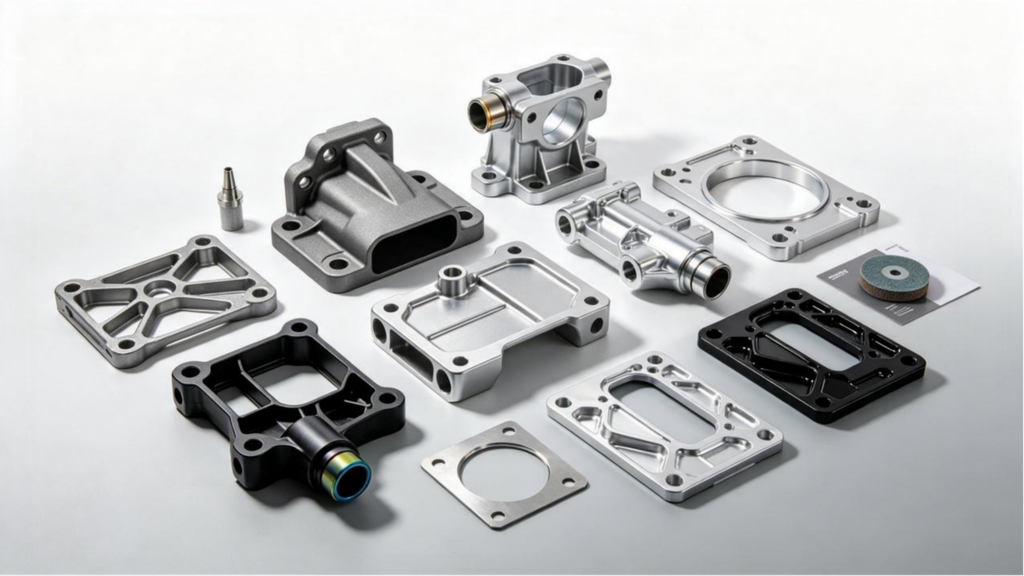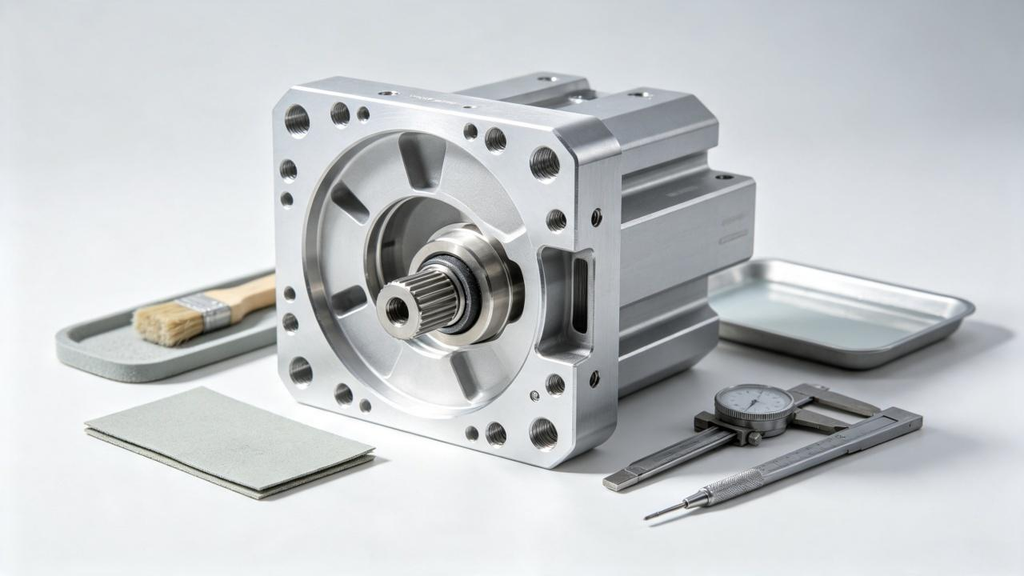
Different alloys deliver unique combinations of mechanical performance, cost, and manufacturability. Among various options, zinc Zamak 5 and aluminum alloys such as ADC12 and A380 are two of the most common materials in industrial applications.
This article provides an in-depth, objective overview of Zamak 5 material properties, compares it with typical aluminum die casting materials, and explores where each alloy performs best.
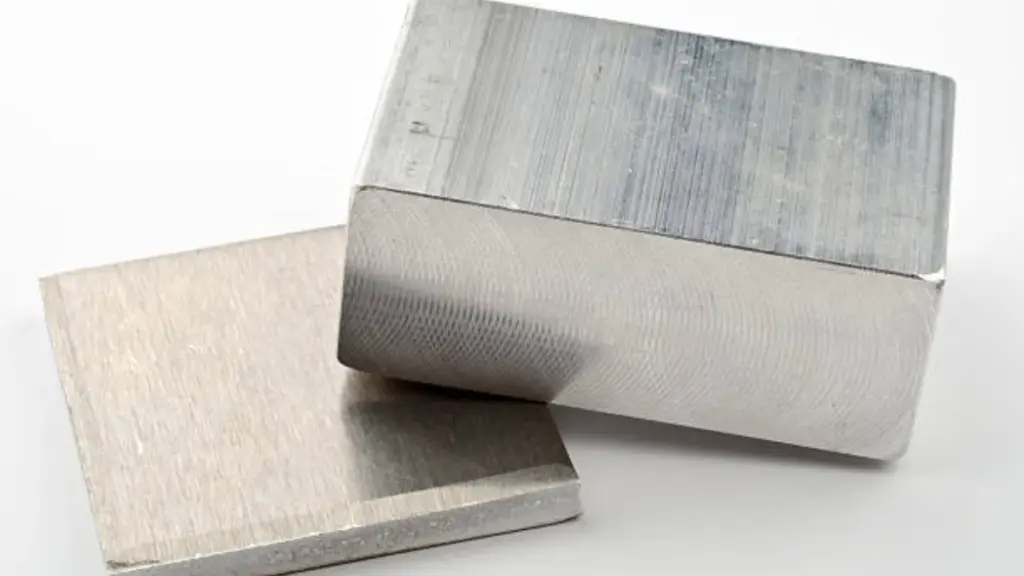
Overview of Zamak 5 Alloy
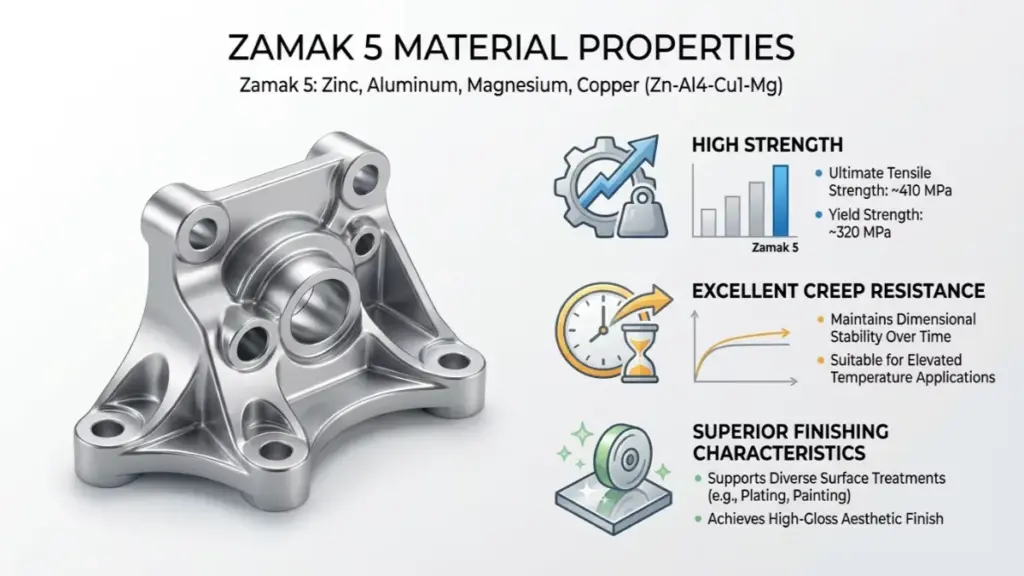
Zamak 5 is a zinc-based die casting alloy that belongs to the family of Zamak (an acronym for Zinc, Aluminum, Magnesium, and Kupfer, i.e., copper) materials. It is well known for its combination of strength, hardness, and excellent surface finishing behavior, making it ideal for decorative and structural parts that demand precision and durability.
Chemical Composition and Properties
Zamak 5’s formulation differs slightly from other Zamak grades due to its higher copper content, which enhances hardness and strength. The typical composition is shown below:
| Element | Content (%) |
|---|---|
| Zinc (Zn) | Balance |
| Aluminum (Al) | 3.5 – 4.3 |
| Copper (Cu) | 0.75 – 1.25 |
| Magnesium (Mg) | 0.03 – 0.06 |
| Iron (Fe) | < 0.075 |
| Lead (Pb) | < 0.005 |
| Cadmium (Cd) | < 0.004 |
The difference between Zamak 3 and Zamak 5 mainly lies in the copper percentage. While Zamak 3 contains minimal copper, Zamak 5 includes nearly 1%, which significantly increases tensile strength and hardness but slightly reduces ductility.
Mechanical and Physical Properties
| Property | Zamak 5 Typical Value |
|---|---|
| Tensile Strength | ~331 MPa |
| Yield Strength | ~260 MPa |
| Elongation | ~7% |
| Hardness (Brinell) | 91 HB |
| Density | 6.6 – 6.7 g/cm³ |
| Melting Range | 380 – 386°C |
| Thermal Conductivity | 109 W/m·K |
| Electrical Conductivity | 27% IACS |
These characteristics make zinc Zamak 5 a preferred choice for small to medium-sized precision parts that need dimensional stability and excellent plating quality. The alloy also supports tight tolerances, which is valuable for applications like mechanical housings or decorative fittings.
Overview of Aluminum Die Casting Alloys (ADC12 / A380)
While Zamak alloys dominate zinc-based casting, aluminum alloys such as ADC12 (used mostly in Asia) and A380 (common in North America and Europe) represent the mainstream materials in aluminum die casting. Their lightweight and thermal performance make them ideal for larger or heat-exposed components.
Typical Composition and Characteristics
| Element | ADC12 (%) | A380 (%) |
|---|---|---|
| Aluminum (Al) | Balance | Balance |
| Silicon (Si) | 9.6 – 12.0 | 7.5 – 9.5 |
| Copper (Cu) | 1.5 – 3.5 | 3.0 – 4.0 |
| Magnesium (Mg) | ≤ 0.3 | 0.1 |
| Iron (Fe) | ≤ 1.3 | ≤ 1.3 |
| Zinc (Zn) | ≤ 1.0 | ≤ 3.0 |
Mechanical and Physical Properties
| Property | ADC12 | A380 |
|---|---|---|
| Tensile Strength | ~320 MPa | ~317 MPa |
| Yield Strength | ~160 MPa | ~180 MPa |
| Elongation | ~1 – 2% | ~3.5% |
| Hardness (Brinell) | ~85 HB | ~80 HB |
| Density | 2.7 g/cm³ | 2.7 g/cm³ |
| Thermal Conductivity | 96 W/m·K | 96 W/m·K |
Aluminum alloys balance strength and low weight, offering exceptional fluidity for complex geometries while resisting thermal distortion. These features are critical for automotive and electronic industries where weight reduction and heat management drive material selection.
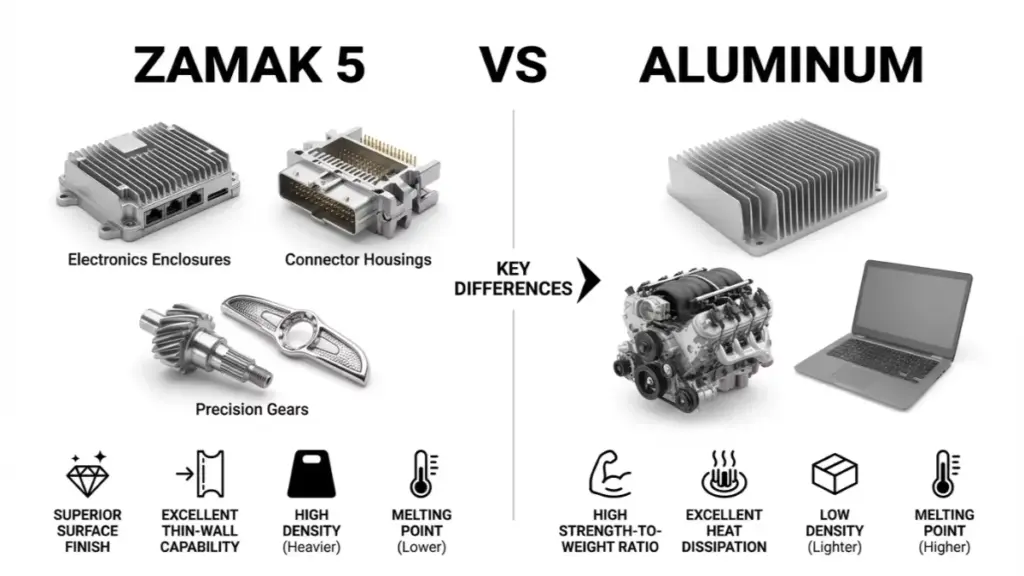
Zamak 5 vs. Aluminum Alloys – Property Comparison
The following sections highlight key differences between zinc Zamak 5 and aluminum casting alloys across mechanical, physical, and production dimensions.
Mechanical and Physical Performance
| Parameter | Zamak 5 | ADC12 / A380 | Key Insight |
|---|---|---|---|
| Tensile Strength | ~331 MPa | ~320 MPa | Comparable strength; Zamak 5 offers better hardness. |
| Hardness | 91 HB | 80–85 HB | Zamak 5 parts resist wear and mechanical stress more effectively. |
| Elongation | ~7% | 1–3% | Aluminum is more brittle; Zamak 5 allows slight deformation before failure. |
| Density | 6.6–6.7 g/cm³ | 2.7 g/cm³ | Aluminum parts are about 60% lighter in weight. |
Zamak 5 exhibits higher dimensional accuracy and hardness, making it ideal for parts where precision and strength at a small size are key, such as latches or gears. Aluminum, on the other hand, is favored where weight reduction and thermal management prevail.
Corrosion Resistance and Surface Finish
Zinc naturally resists corrosion due to its stable oxide layer, giving zinc Zamak 5 strong performance in humid or oxidizing conditions. Additionally, Zamak 5 easily supports electroplating, painting, and chromating.
Aluminum provides decent corrosion resistance but requires surface treatments such as anodizing or powder coating to enhance durability and appearance. It is especially suitable for outdoor structural components.
| Aspect | Zamak 5 | Aluminum (ADC12 / A380) |
|---|---|---|
| Natural Corrosion Resistance | Excellent | Good |
| Plating / Painting | Superior (mirror finish possible) | Good (anodizing preferred) |
| Aesthetic Applications | Excellent | Moderate |
| Environmental Durability | High | High (after coating) |
Casting and Production Characteristics
Another crucial distinction is casting behavior. Zinc Zamak 5 melts at a lower temperature (around 385°C vs. aluminum’s ~660°C), resulting in lower energy consumption, shorter cycle times, and extended mold life.
However, Zamak alloys are denser and less suitable for large parts due to weight and higher material cost per volume.
| Parameter | Zamak 5 | Aluminum ADC12 / A380 |
|---|---|---|
| Melting Temperature | ~385°C | ~660°C |
| Cycle Time | Shorter | Moderate |
| Mold Life | Longer | Shorter |
| Suitable Part Size | Small to medium | Medium to large |
| Dimensional Stability | Excellent | Good |
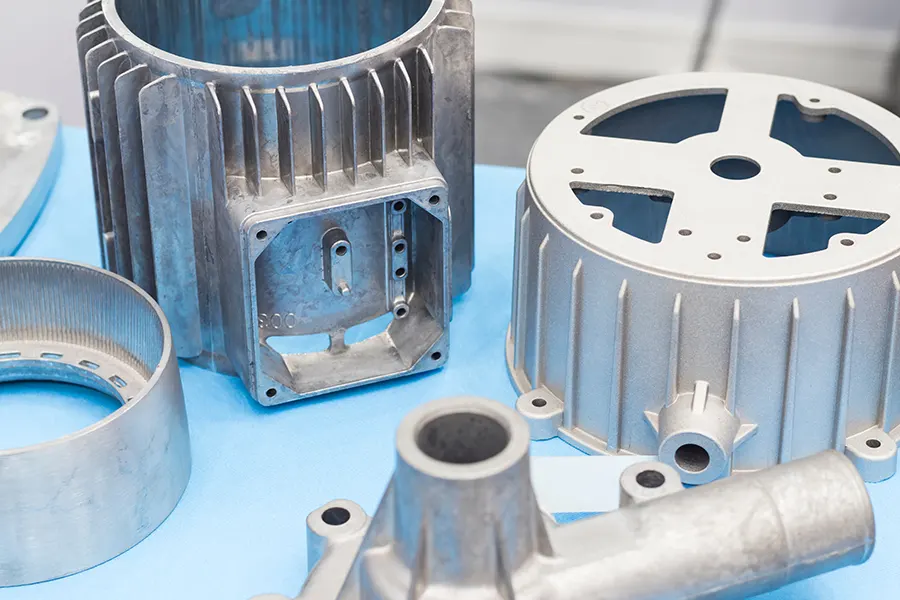
Zamak die casting supports thin walls and precise tolerance control without secondary machining, while aluminum dies better support larger, heat-dissipative housings or frames.
Choosing the Right Material for Your Application
The “right” choice between Zamak 5 and aluminum depends entirely on application goals.
Here are some guiding factors to consider:
- Component Size and Weight:
- Aluminum is preferred for larger or lightweight structures.
- Zamak 5 works best for compact, precision-engineered components.
- Strength and Load Requirements:
- Both alloys offer strong performance, but Zamak 5 provides superior hardness and wear resistance in small mechanisms.
- Surface Aesthetics:
- For products requiring decorative chrome or paint finishes (e.g., handles, fixtures), Zamak 5 usually outperforms aluminum.
- Thermal and Electrical Needs:
- Aluminum wins where conductivity and heat dissipation matter (e.g., engine or electronic housings).
- Production Efficiency and Cost:
- Zinc alloys deliver higher tooling life and faster cycles.
- Aluminum’s lower material density often reduces part cost per piece when large volumes are required.
In essence, Zamak 5 fills the niche for high-precision, small metal parts, while aluminum alloys remain the industry standard for large, lightweight castings.
BIAN’s Expertise in Die Casting Solutions
With years of technical experience in aluminum die casting, BIAN provides comprehensive engineering support—from mold design and alloy selection to surface treatment and final assembly.
Our engineering team is proficient in working with a variety of alloys, including zinc Zamak 5 and aluminum grades like ADC12 and A380, ensuring customers receive objective and application-specific material advice.
Conclusion
The comparison between Zamak 5 and aluminum die casting alloys highlights that both have unique advantages:
- Zamak 5 offers superior surface finish, hardness, and tolerance for intricate designs.
- Aluminum alloys bring lightness, thermal efficiency, and cost effectiveness to large-scale components.
Rather than a direct competition, these alloys complement each other across different engineering needs.
BIAN’s role is to help clients navigate these choices with data-driven insight and technical expertise, ensuring the final product achieves the best balance between design intent, performance, and production efficiency.